OPERATION ENDURANCE
The price tag, by Newsweek.
Showing posts with label OIF. Show all posts
Showing posts with label OIF. Show all posts
Tuesday, January 12, 2010

Tuesday, March 06, 2007
A Deadly Revolving Door
One starts to see how Saddam's system of nesting groups to watch other groups (including "stiffners") may have gotten its impetus: weak policing within the ranks.
For at least the second time in the past 5 months, some of the most dangerous terrorists have been able to escape from an Iraqi jail guarded by Iraqi police. Today, militants stormed Mosul's northwestern Badoush prison and freed over 140 prisoners, most of whom are described as "insurgents." You can bet they weren't traffic violators; they were probably key operatives in terrorist cells who were painstakingly hunted down by the U.S. military and Iraqi army. The overwhelmed police asked the U.S. military for help, but too late to stop the escaping terrorists - Andrew Cochran, CT Blog
Sunday, March 04, 2007
Battle for Baghdad: By the Numbers, Feb Update
The guys over at Fourth Rail (linked on right) have put up an update to the Baghdad Order of Battle, which includes, broadly speaking, and update on the deployment/control of the Iraqi 6th Division and the "Augments" that have been pulled in as part of the Baghdad Security Plan. (Be sure to scan the reader comments, as well.)
The amount of work being put in to keep that blog spiffy is worth a medal. Bill is now doing daily updates (link).
Months ago, Rumsfeld said that we would find out if the 'parties in Iraq' would be willing to bet 'their future on a piece of paper', the new Iraqi Constitution. I wonder if he was thinking about the majority government and whether they would abide by rule of law, even when provoked ...
BACKGROUND:
There is a very worthy glossary attached to the OOB.
For those skimming this material who need a little structure background, the basic org units run as follows:
Division (DIV) - 10-15K organized into Brigades
...Brigades (DBE) - 1st sub-unit
......Battalions (BN) - next sub-unit
......includes: Support Battalions (BSB, supply/support and BSTB, headquarters)
.........Company (CO) - sub-unit of Battalion
............Platoon (PT) - sub-unit of Company
IA - Iraqi Army
IAD - Iraqi Army Division
IGFC - Iraqi Ground Forces Command
Wednesday, February 21, 2007
Tracking the Surge: Uneasy Silence at COP Charlie, Ghazaliyah
Time reporter Charles Crain writes about an eering silence in Ghazaliyah (see posts on Baghdad Conurbation for general info on Baghdad neighborhoods).
Meanwhile the militia and the insurgents have been finding ways to operate under the radar and out of firing range. On the streets of Ghazaliyah, Sgt. Michaud said, the Mahdi Army continued to "slowly, but surely," force Sunnis from their homes through other forms of intimidation. The more immediate threat, though, may be a spectacular Sunni insurgent attack designed to show residents in Ghazaliyah that their power has not been blunted. "If I'm the enemy: I've lost the initiative," Peterson said. "I've got to do something big and visual."
This suggests that the coordinated attack on the Tarmiya COP and the massive car bomb explotion earlier in the month were related to changing tactics, rather than outright indicators of new strength in the insurgency.
Sadly, however, dividing lines remain:
In Ghazaliyah, northeast of Baghdad's airport, Iraq's savage and complex civil war has been playing out in miniature. Moqtada al-Sadr's Mahdi Army militia has been encroaching from Shula, the Shi'a-dominated neighborhood to the north. The Sunni minority has virtually vanished from northern Gazaliyah, driven away by murder and intimidation. In the heavily-Sunni southern part of the neighborhood homegrown insurgents and foreign jihadists have been attacking the Americans and Shi'a-dominated security forces.
The COP is a short drive from the road that serves as a dividing line between Ghazaliyah's Sunni and Shi'a communities. Moved from its home at Camp Liberty, one of the bases within the sprawling American compound at the airport, Charlie Company fortified a row of houses with concrete, razor wire and plenty of firepower. The COP is the first test of the counter-insurgency strategy the military plans to implement across Baghdad.
Thursday, February 15, 2007
A View from the Frontlines

Some comments from the guys at COP (Combat Post) Falcon, in Ramadi, courtesy the Army Times.
"So, every day ... every single day they have to look around and deal with the fact that they are under small arms contact daily."
"We have spilt blood here...we've invested really our lives for making this area of Ramadi better."
Wednesday, February 07, 2007
ISF Deployment
The guys at the Fourth Rail are indispensable for understanding what is really going on in Iraq.
They've compiled and collated a lot of open-source material about the development and deployment of the ISF. I've been trying to get information on the Iraq 6th Division, who have responsibility in Baghdad.
Anyway, at least someone is trying to provide some systematic information, at least enough so that folks have a sense of forward or backward motion on some metrics, a step that can only help, IMO. The concerns about sharing too much info with 'the enemy' are slim, in my estimation. It's their country and they appear to know quite well who is where and doing what already, judging by the effectiveness of some of their attacks.
link: Order of Battle
Saturday, February 03, 2007
Update: Iraqi Police Readiness
Adding this to General Eaton's testimony (I don't recall him shining a spotlight on government contractors).
I was always one for spending money, even without the ordinary controls/oversight, in the hope that the tradeoff would be effectiveness or speed-on-the-ground.
However, some parts seem to have been just plain old fraud and incompetence, the till too tempting:
Reports Fault Oversight of Iraq Police Program
Millions Paid to Contractors Squandered on Unauthorized Work, Shoddy Facilities, U.S. Auditors Say
WaPo
Democracy, Form Not Substance
In his latest, Fareed Zakaria shows how the debate has changed from whether Democracy is compatible with Islam to whether Democracy, broadly put, can combat "old-world hatreds", as I call 'em. He also throws in corruption.
I suspect this could and will occupy political science PhDs and sociologist for a long while.
How does it come to pass that democratically elected governments do not trend away from corruption of the public interest?
How does it come to pass that a populace fails to elect a government that is responsible to the whole people, not just a portion of it?
Journalistic melange: Three sides to the same story
I cobbled together these three accounts of the joint effort on Haifa street, Baghdad, on January 24th.
The contrast between them was stark enough to illustrate the difficulty of getting decision quality information, I thought. And, in other ways, taken together, they are a microcosm of reporting and analysis challenges.
From the USG, the official recap:
Iraqis, Coalition reestablish security on Haifa
Saturday, 27 January 2007
Story and photo by Spc. Shea Butler
7th Mobile Public Affairs DetachmentJan.24.BAGHDAD — The company of Soldiers starts the day before the sun, knowing in the back of their minds that it is going to be a long day full of fire fights with the enemy. As grenades detonate around them and bullets fly by, they target the enemy and engage immediately, proving that “courage is the absence of fear.”
For the second time in the past several weeks, Soldiers from 1st Battalion, 23rd Infantry Regiment, 3rd Stryker Brigade Combat Team, 2nd Infantry Division teamed up with Iraqi Army troops to take on insurgents on Haifa Street, in Baghdad’s Karkh district Jan. 24.
The Haifa Street operation, dubbed Operation Tomahawk Strike 11, aimed to disrupt insurgents in order to establish security, said Capt. Isaac Torres, commander, Company C, 1-23 Inf.
The Soldiers started the operation at 3 a.m. when they gathered for pre-combat inspections, received the updated status of the area of operation and piled in their Strykers. They were prepared for a long day. They expected enemy fire
...
While the NCOs were vigilant, the junior enlisted troops didn’t need much guidance. They have been in similar dangerous fire fights.
“They have all been in enough fire fights to know what is going on,” McCallum said. “They know all the rules of engagement.”
Training is part of what helped these Soldiers through the long day, but adrenaline helped too.
“It was a long day but there was so much adrenaline it made easier,” he said. “We took shots through some windows and adrenaline really kicked in. We immediately got on line, located the enemy and suppressed fire.”
Firing slowed down greatly towards the end of the day. When the smoke cleared, 21 insurgents had been detained and a weapons cache uncovered.
“The mission was a success,” Torres said. “The enemy was greatly disrupted and the Iraqi Army and coalition forces made an impact”
link
From a combo of embedded and desk reporting (apparently), from the NYT (take notice, at the end, how one Iraqi soldiers knows and apparently dislikes the accountability role of reporters):
In a New Joint U.S.-Iraqi Patrol, the Americans Go First
BAGHDAD, Jan. 24 — In the battle for Baghdad, Haifa Street has changed hands so often that it has taken on the feel of a no man’s land, the deadly space between opposing trenches. On Wednesday, as American and Iraqi troops poured in, the street showed why it is such a sensitive gauge of an urban conflict marked by front lines that melt into confusion, enemies with no clear identity and allies who disappear or do not show up at all.
In a miniature version of the troop increase that the United States hopes will secure the city, American soldiers and armored vehicles raced onto Haifa Street before dawn to dislodge Sunni insurgents and Shiite militias who have been battling for a stretch of ragged slums and mostly abandoned high rises. But as the sun rose, many of the Iraqi Army units who were supposed to do the actual searches of the buildings did not arrive on time, forcing the Americans to start the job on their own.
When the Iraqi units finally did show up, it was with the air of a class outing, cheering and laughing as the Americans blew locks off doors with shotguns. As the morning wore on and the troops came under fire from all directions, another apparent flaw in this strategy became clear as empty apartments became lairs for gunmen who flitted from window to window and killed at least one American soldier, with a shot to the head.
...
“This place is a failure,” Sergeant Biletski said. “Every time we come here, we have to come back.”
He paused, then said, “Well, maybe not a total failure,” since American troops have smashed opposition on Haifa Street each time they have come in.
With that, Sergeant Biletski ran through the billowing yellow smoke and took up a new position.
In this surreal setting, about 20 American soldiers were forced at one point to pull themselves one by one up a canted tin roof by a dangling rubber hose and then shimmy along a ledge to another hut. The soldiers were stunned when a small child suddenly walked out of a darkened doorway and an old man started wheezing and crying somewhere inside.
Ultimately the group made it back to the high rises and escaped the sniper in the alley by throwing out the smoke bombs and sprinting to safety. Even though two Iraqis were struck by gunfire, many of the rest could not stop shouting and guffawing with amusement as they ran through the smoke.
One Iraqi soldier in the alley pointed his rifle at an American reporter and pulled the trigger. There was only a click: the weapon had no ammunition. The soldier laughed at his joke.
NYTimes
Last, a newsview reinforced by a slant (a good one, IMO), of the consequence of sectarian divisions for most (if not all) decision making inside Iraq:
We Might 'Win', But Still Lose: Lt. Col. Steven Duke says the Mahdi Army is 'sitting on the 50-yard line, eating popcorn, watching us do their work for them.'Administration officials have pointed to last week's fighting against Sunni insurgents in and around Baghdad's Haifa Street as a textbook example of the new strategy. Iraqi forces took the lead, American troops backed them up and the government did not put up any obstacles. The Wall Street Journal's Daniel Henninger concluded that the battle "looked like a successful test of unified [American-Iraqi] effort."
But did it? NEWSWEEK's Michael Hastings, embedded with an American advisory team that took part in the fighting, reports that no more than 24 hours after the battle began on Jan. 6, the brigade's Sunni commander, Gen. Razzak Hamza, was relieved of his command. The phone call to fire him came directly from the office of Prime Minister Nuri al-Maliki, a Shiite. Lt. Col. Steven Duke, commander of a U.S. advisory team working with the Iraqis, and a 20-year Army veteran, describes Hamza as "a true patriot [who] would go after the bad guys on either side." Hamza was replaced by a Shiite.
Newsweek, Zakaria
Monday, January 29, 2007
Sizing Up the Baghdad Conurbation II
Not having a back-of-the-hand knowledge of Iraqi geography, I often find news reports that reference towns and cities without adequate graphics to be hard to judge.
It's been hard to find decent maps of Baghdad, ones that are easily usable. Here is my ongoing effort to add dimension to empower readers. (By the way, if you don't know what a "conurbation" is perhaps that's enough to inspire a budding geographer).
The General Areas

Basic Ethnicities:
* Adhamiyah: Sunni majority, Shiite presence.
A majority Sunni area on the eastern side of the Tigris River, A'dhamiyah is home to the shrine of Imam Abu Hanifa, an eighth century Sunni scholar, and the Imam al Adham mosque, built above the shrine and for whom A'dhamiyah is named. Under Saddam Hussein, A'dhamiyah was considered one of the most affluent neighborhoods in Baghdad, home to political leaders, professionals and business people. During the first days of the U.S. invasion of Iraq in 2003, Saddam Hussein was believed to be hiding in A'dhamiyah before heading north to his hometown of Tikrit. Today, A'dhamiyah still is considered a middle class Sunni neighborhood, with minority Shiites being rapidly expelled. And, despite the establishment of a neighborhood patrol, attacks are frequently carried out on Iraqi security forces and American troops in the area.-PBS News (date unknown)
* al-Kadhimya: Shiite majority.
Kadhimiyah is considered one of the safest and most peaceful areas of Baghdad. The shrine of Imam Musa al-Kadhim located here is heavily protected and the neighborhood is home to a large American military base. A mostly residential area, Kadhimiyah is second only to the holy cities of Najaf and Karbala to Shiites. According to Iraqis living in Baghdad, few outsiders venture into Kadhimiyah because of its location to the north, its relatively small size and generations of families helping keep it safe. In August 2005, the bridge connecting Kadhimiyah to Adhamiyah across the Tigris River was the scene of a deadly stampede that killed an estimated 1,000 people. Once a highly cosmopolitan area of the city with predominantly Shiites and some Sunni professionals living harmoniously, few Sunnis remain.-PBS News (date unknown)
* Karrada: Shiite majority, Christian presence.
One of Baghdad's most upscale neighborhoods, Karrada sits in the southeastern part of Baghdad where the Tigris River bends and forms a horseshoe before heading south. The neighborhood is almost fully surrounded by the river and has infrastructure in good condition, some office buildings, banks and stores, along with some of the best restaurants and nightlife in Baghdad. Considered a culturally mixed, cosmopolitan area with a variety of writers, artists and intellectuals, Karrada is home to mostly Shiites, many Sunnis and pockets of Christians, but also foreigners. Though thought of as a generally safe area, the neighborhood has witnessed several car bombings, and in March 2004 was the site of a deadly bombing at the Jabal Lebanon hotel that killed 27 people.-PBS News (date unknown)
* Al-Mansour: Mixed area.
Saddam Hussein's son, Uday Hussein, lived in the Mansour district, an upper class area of Baghdad. In the 1990s, Uday was known to cruise the streets of the neighborhood scouting for young women. An attempt was made on Uday's life in 1996 -- his Porche was riddled with bullets and he was shot 17 times -- some say at the hands of the family of a young girl he had raped. Others say residents of Dujail, a town north of Baghdad where 148 Shiites were massacred in 1982, were the would-be assassins. Under Saddam, Mansour was home to artists, writers, business people and military officers. In 2003, during the toppling of Baghdad, the Al Jazeera news network accused the U.S. military of protecting the Ministry of Oil, located in Mansour, while letting other parts of the city burn. Today, parts of Mansour lie in the coalition-controlled Green Zone, and the area, once home to foreign embassies, boasts the best infrastructure in Baghdad.-PBS News (date unknown)
* Dora: Mixed area.
Famous for housing one of the largest oil refineries in Iraq, Dora is a mixed Sunni, Christian neighborhood with a Shiite minority. Since 2005, Sunni extremists have worked to expel Shiites from the neighborhood, drawing retaliation from armed Shiites who entered the neighborhood from other Shiite strongholds to provide protection. One of the main areas of conflict in Baghdad, Dora has been the site of bloody clashes between insurgents and American troops. The area also has seen a slew of abductions, bombings and assassinations.-PBS News (date unknown)
* Baghdad Al-Jadida (New Baghdad): Shiite majority, Christian presence.
Called New Baghdad in English, Baghdad al-Jadida was created in the 1950s under a land expansion program and was populated by mainly middle class, working Baghdadis. Residents were salaried bureaucrats, many educated and working for the government. Today, Baghdad al-Jadida is a mixed Shiite-Sunni area with a Shiite majority and a small population of Christians. The area is residential, lightly industrial with family-owned businesses that cater to the neighborhood. Residents typically bus to central Baghdad for work. The neighborhood, considered relatively safe, was the site of a suicide bombing at a crowded gas station in February 2006 that killed 23 people and wounded 51.-PBS News (date unknown)
* Sadr City [Thawra]: Almost exclusively Shiite.
A Shiite slum of some 2 million people in the northwest section of Baghdad, Sadr City, once called Saddam City, was renamed for a prominent Shiite religious family after the dictator's fall. The area was built in the late 1950s, part of a scheme carried out by Iraq's first dictator Abdul Karim Qasim. At that time, poverty-stricken residents were given tents as homes. They served as the labor force for the rest of Baghdad. The area was once the headquarters of the Sadr Foundation, a religious organization headed by Grand Ayatollah Muhammad al Sadr, father of rebel Shiite cleric Muqtada al Sadr. The organization ran hospitals and provided services for the poor. Today, Sadr City residents, who still live in extreme poverty, have concrete homes and running water but little in the way of infrastructure -- the worst in Baghdad, according to many. The area is the stronghold of Muqtada al-Sadr's Mahdi Army. In November 2006, Sadr City was the scene of one of the worst bombings in Iraq's history. The bombings -- a series of attacks that killed more than 200 people -- led to a five-day curfew.-PBS News (date unknown)
* Hurriya City [near "Kadymiha" in general pic above]: Shiite majority, Sunni presence.
Hurriya City is mainly Shiite with a small Sunni population that is quickly disappearing. The area, like Shu'la and Sadr City, is a stronghold of rebel Shiite cleric Muqtada al-Sadr's Mahdi Army. Socioeconomic conditions are poor as is the infrastructure. Hurriya is a lower middle-class, residential neighborhood that along with Sadr City and Shu'la comprises nearly half of Baghdad's population.-PBS News (date unknown)
* al Shula [South-eastern part of "Kadymiha" in general pic above]
Shu'la is another Shiite enclave that has witnessed the mass expulsion of its small Sunni population. Like Sadr City and Hurriya, Shu'la is controlled by Shiite cleric Muqtada al-Sadr's Mahdi Army. The area is poor and considered a slum by most Baghdad residents. In Iraq's first election since Saddam Hussein's ouster, residents of Shu'la voted largely for the Shiite-led United Iraqi Alliance in 2005.-PBS News (date unknown)
Ad-hoc map of ethnic mixes:

Population estimates of major areas:
| Major Cities | Governate | Population 1987 SOURCE | Population 2002 SOURCE | |
|---|---|---|---|---|
| Baghdad Conurbation | ||||
| 1 | BAGHDAD | Baghdad | 3,841,268 | 5,605,000 |
| Kadhimain | 521,444 | |||
| Adhamiya | 464,151 | |||
| Mamoon | 244,545 | |||
| Karradah Sharqiyah | 235,554 | |||
| Abu Ghurayb | ||||
| Sadr City | ||||
| Other Cities | ||||
| 2 | Mosul | Nineveh / Ninawa | 664,221 | 1,739,000 |
| 3 | Basrah | Basrah | 406,296 | 1,337,000 |
| 4 | Irbil | Arbil | 485,968 | 839,000 |
| 5 | Kirkuk | At-Ta'mim | 418,624 | 728,000 |
| 6 | Sulaymaniyah | As-Sulaymaniyah | 364,096 | 643,000 |
| 7 | Najaf | An-Najaf | 309,010 | 563,000 |
| 8 | Karbala | Karbala | 296,705 | 549,000 |
| 9 | Nasriye | Dhi-Qar | 265,937 | 535,000 |
| 10 | Hilla | Babylon [Babil] | 268,834 | 524,000 |
| 11 | Ramadiyah [Ar Ramadi] | Al-Anbar | 192,556 | 423,000 |
| 12 | Diwaniyeh | Al-Qadisiyah | 196,519 | 421,000 |
| 13 | Kut | Wasit | 183,183 | 381,000 |
| 14 | Amarah | Maysan | 208,797 | 340,000 |
| 15 | Ba'qubah | Diyala | 280,000 | |
| 16 | Fallujah | Al-Anbar | 256,000 | |
| 17 | Samarra' | Salah ad-Din | 201,000 | |
| 18 | Az Zubayr | Basrah | 168,000 | |
| 19 | Tall 'Afar | Nineveh / Ninawa | 155,000 | |
| 20 | As-Samawah | Al-Muthanná | 124,000 | |
| 21 | Bayji | 120,000 | ||
| 22 | al-Kûfah | An-Najaf | 115,000 | |
| 23 | as-Satrah | Diyala | 83,000 | |
| Ad Duluiyah | 50,000 | |||
| Dahuk | Dahuk | 47,000 | ||
| Tikrit | Salah ad-Din | 28,000 | ||
Sunday, January 28, 2007
Sizing Up Baghdad
The folks over at cockeyed.com have kindly provided the comparisons, to give a sense to readers of the relative size of Baghdad and its suburbs compared to known size of various U.S. cities:
Baghdad:
Los Angeles:
New York:
Chicago:
San Francisco:
Washington, D.C.:
Saturday, January 27, 2007
Is Baghdad a Maelstrom?
Without any *systematic* information on the conflict in Iraq, just ad-hoc reporting, two articles surface suggesting that Baghdad is a maelstrom.
From The Independent, a sense that the siege mentality is *complete* and that the fortifications are growing, not even holding the same (enlarged enough to shoot down helicopters over Baghdad, bold enough to kidnap mayors in Baquba and to storm council meetings in Karbala in broad daylight using uniform disguises and fancy, black SUVs).
From the NYT, a description of the effort to settle down one district, Ghazaliya.
Oddly, here is a map from last September indicating that MNF-1 thought Ghazaliya (area 2) was "cleared":
Thursday, January 25, 2007
Falcon Bridgade of 82nd is on the ground in Baghdad
Wednesday, 24 January 2007
By Sgt. Mike Pryor 2nd Brigade Combat Team, 82nd Airborne Division
BAGHDAD — The 82nd Airborne Division's 2nd Brigade Combat Team arrived in Baghdad last week as part of the first wave of a planned escalation of forces in Iraq's capital city.
...
The Falcon Brigade is one of the most combat-experienced units in the Army. Paratroopers from the 2nd BCT have deployed six times on short-notice deployments since the war on terrorism began.
..
The Falcons arrived in Baghdad trained, equipped and ready to fight. Now that they've put boots on the ground, it will be up to the young paratroopers and junior noncommissioned officers to make sure the mission gets completed, said Staff Sgt. Jack Butler, a platoon sergeant with Company C, 1st Battalion, 504th Parachute Infantry Regiment. Butler said he has no doubt they will rise to the challenge."Whatever they put out in front of us," he said, "we're going to be able to tackle."
MNF link
OPERATION TOMAHAK 11
...joins its predecessors, Operation Lightening and Operation Together Forward, with a amazing complement of ... well, everyone!:
Soldiers with the 1st Brigade, 6th Iraqi Army Division, officers from the 5th Iraqi National Police Brigade and elements of the U.S. 2nd Brigade Combat Team, 1st Cavalry Division and 3rd Stryker Brigade Combat Team, 2nd Infantry Division initiated raids as part of Operation Tomahawk Strike 11 on Haifa Street to disrupt illegal militia activity and help restore Iraq security force control in the area.
http://www.defenselink.mil/News/NewsArticle.aspx?id=2798
Saturday, December 09, 2006
Iran, early response to new diplomatic initiative ...
Long and excellent summary of US-Iran relations post-OIF,
Engaging Iran on Iraq: At What Price and to What End?
By Patrick Clawson December 5, 2006
The United States and the Islamic Republic of Iran have a long history of direct bilateral talks. For example, during the Taliban days, the two sides met often about Afghanistan, though always with at least one outside representative present to maintain the official cover that the talks were not bilateral. Iranian and American officials also met before and during the United States’ entry into Iraq, convening at least three times in 2003—in January, March, and May—to discuss the Iraq situation. While a UN official opened each meeting to preserve the fiction that they were not bilateral sessions, the official soon left the two delegations on their own.
Direct U.S.-Iranian talks ceased in 2003.
On October 19, 2005, Secretary of State Condoleezza Rice announced, “We have considered whether contacts that are specifically related to Iraq might be useful between Ambassador [to Iraq Zalmay] Khalilzad and his counterpart on the same basis that we had them, essentially, in Afghanistan.” Administration officials later clarified that such talks were in fact authorized. Khalilzad is a native Persian speaker who conducted pre-invasion talks with Iran about Afghanistan. On October 20 [notice how prompt their public diplomacy 're-action' is ...], 2005, Iranian Foreign Ministry spokesman Hamid Reza Asefi stated that Iran saw no reason to talk to the United States until it “revises its behavior and attitude,” a view repeatedly echoed by other Iranian officials in the following months.
On March 16, 2006, five months after Rice made the offer for talks, Iranian National Security Council secretary Ali Larijani accepted the offer, saying, “We agree to talk to the Americans,” while emphasizing that Iran was acting because of a request by Abdalaziz al-Hakim, leader of the Supreme Council for the Islamic Revolution in Iraq (SCIRI). However, that position was reversed by President Mahmoud Ahmadinezhad, who stated on April 24, “By God’s will, we think that right now, because of the presence of a permanent government in Iraq, there is no need” for talks with the United States.
[continue reading, high reccomended summary of Iranian views accross the political spectrum]
In the LA Times (before ISG-Report):
An official Iranian source, who spoke on condition of anonymity, said Iran's position was unchanged and continued to urge a quick U.S. withdrawal.
"We oppose the Western forces continuing the occupation there. As long as they are there, we think the violence in this situation will continue, and it does not help whatsoever the stability in the region," he said.
Another official source echoed that view. "Why would the U.S. think that their rapid withdrawal would be rejected by Iran? Do they think their presence is a help? Iran thinks it is not," he said.
From the redoubtable BBC, although it is hard to judge the basis or veractiy of these items:
Iran wants a wholesale transformation of its relationship with the United States, which is one of the most antagonistic in the world. [by their choice? for their purpose?]
At the moment attention of the US and its allies is on Iran's nuclear programme which they say is intended to produce a non-conventional military capability.
Iran wants to be allowed to continue its programme - including uranium enrichment - which it says is completely peaceful [but ignores the IAEA's requests that might shed light on that assertion?] as well as its right under the international non-proliferation regime.
That means an end to the threat of UN sanctions - which Tehran has been able to avoid so far - and an end to US and Israeli threats of military action to destroy its nuclear facilities.
In the past, Tehran has had its fingers burnt [?] by trying to open a dialogue with this most hawkish of US administrations.
In May 2003, for example, it offered to open up its nuclear programme, rein in Hezbollah and co-operate against al-Qaeda, but was reportedly rebuffed as the insistence of former Defence Secretary Donald Rumsfeld and Vice-President Dick Cheney. [is that all true?]
A VERY SMART VIEW ABOUT WHAT TO DO DIPLOMATICALLY
“In my personal opinion, the Arab League needs to talk to Iran,” says El Reedy, who is a member of CFR’s international advisory committee and chairman of the Egyptian Council on Foreign Relations. El Reedy says “Iran is already a power, a force, a factor, in the Middle East and the Arab nations.” He said if high-level talks are held between Iran and leading Arab states, “then we could maybe find some intermediary and the feelings could cool off” in Lebanon.
Friday, December 01, 2006
A View from the North

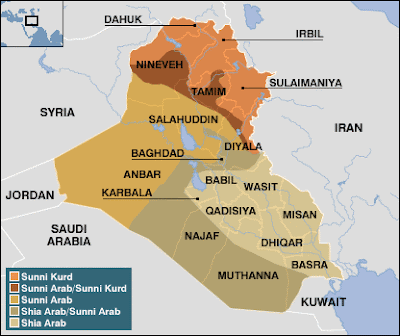
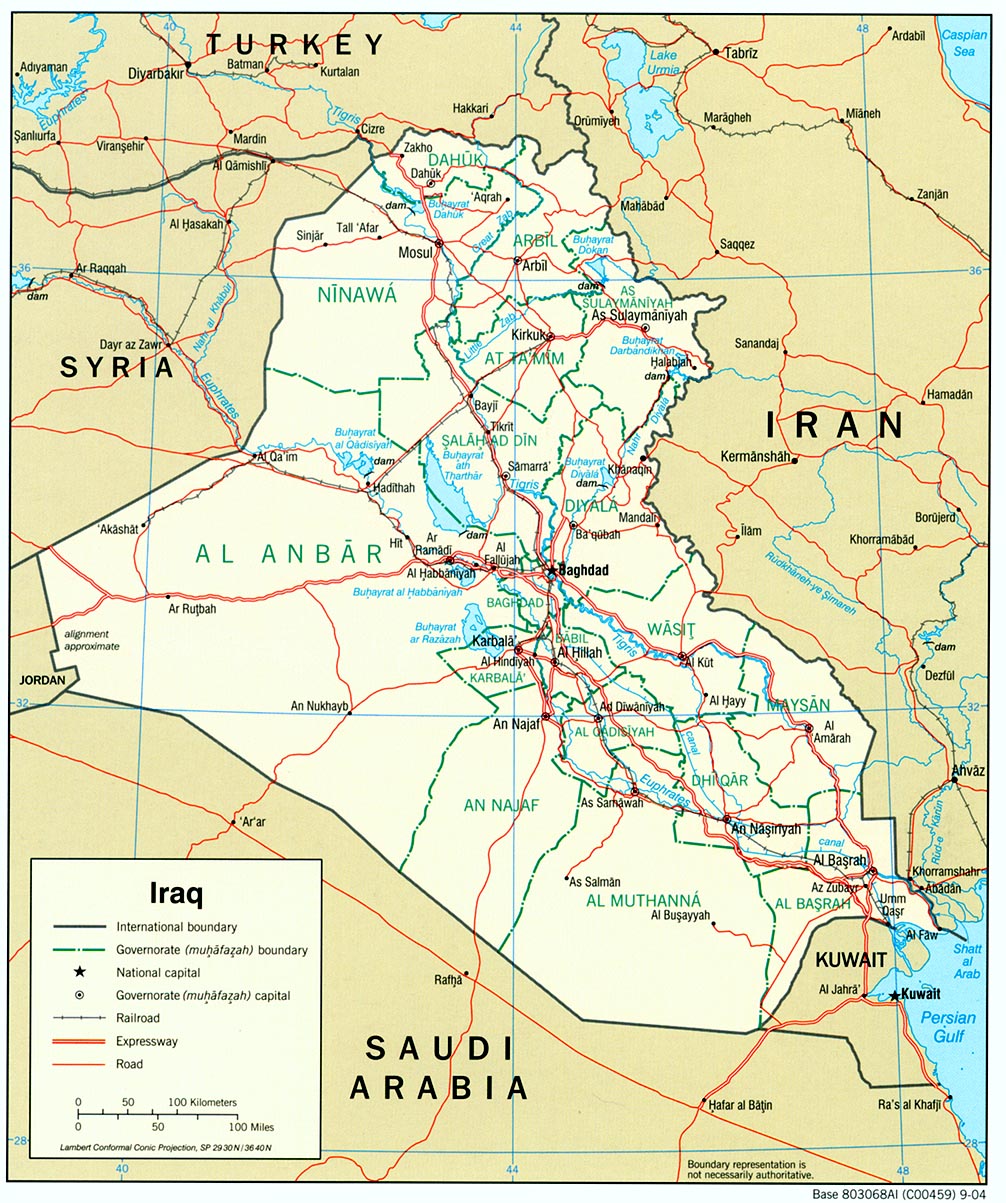 casualties by province; general ethnicities by province; northen cities
link: MG Mixon, new guy on the block, gives a view from the North:
- Two of six Provinces quiet (Sulaymaniyah, Dahuk) area of 11 million people the size of Pennsylvania, roughly.
- At-Takim (Kirkuk) and Salah ad-Din suffer attacks on infrastructure
- Diyala (Ba'qubah, etc.) terorrist induced sectarian violence, with militia counter-attacks and corruption of police/army
- Nineveh - today (Dec 1) gets first division completely solely under IGFC (Iraqi Ground Froces Control)
Police, army, and border security forces -- all in play
Five divisions to be completely under IGFC by February.
I got the sense that training was going to be 'on-the-job', to accelerate the transitions, rather than via an approach of 'schoolroom first' and field-experience later (cf. "mobile training teams" ...).
Little comment on the role of the Peshmurga.
UPDATES LACK STRATEGIC CONTEXT
We get a sense of some forward motion from these snap-shot pictures. Some things are moving in the right direction.
What is the target structure of the Iraqi forces and what is the projected percentage completion? Perhaps four divisions is enough, but the size of battlions can vary, so its not clear how many this involves. 36,000 police is impressive, but how many more are needed to reach critical mass or widely accepted civilian protection ratios?
Background:
During the late 1970s and the mid-1980s, the Iraqi armed forces underwent many changes in size, structure, arms supplies, hierarchy, deployment, and political character. Between 1980 and the summer of 1990 Saddam boosted the number of troops in the Iraqi military from 180,000 to 900,000, creating the fourth-largest army in the world. With mobilization, Iraq could have raised this to 2 million men under arms--fully 75% of all Iraqi men between ages 18 and 34. The number of tanks in the Iraqi military rose from 2,700 to 5,700 and artillery pieces went from 2,300 to 3,700.
The regular Army in mid-1990 consisted of more than 50 divisions, additional special forces brigades, and specialized forces commands composed of maneuver and artillery units. Although most divisions were infantry, the Army had several armored and mechanized divisions. Some armored units had a small amount of modern Western and Soviet equipment, but most of the Army had 1960s-vintage Soviet and Chinese equipment. Training and equipment readiness of Army units varied greatly, ranging from good in the divisions that existed before the Iran-Iraq war, to poor in the largely conscript infantry formations.
http://www.globalsecurity.org/military/world/iraq/army.htm
Thursday, November 30, 2006
"Fallujah today is a boom town" for construction
Video-link briefing from Marine Col Larry Nicholson, Regimental Combat Team 5 Commander (The Fighting Fifth, the Marine Corp's most decorated unit).
Facts on the ground, the rest of the picture:
- Elected, functional city government, despite intimidation campaign
- populace has returned following violence / earlier pacification campaigns,
- relative safe-haven status vis-a-vis current Baghdad,
- U.S. troop drawdown from 3,000 to 300; nine Iraqi battalions - needs to double
- Americans working alongside Iraqis, including businessmen; but police development is slow.
- Six entry points to the city,
- everyone with ID-resident badges (no refugee camps - families in Fallujah help those displaced in need),
- five (5) incidents a day, including non-lethal, in overall city of 400,000
Video Link
Wednesday, November 01, 2006
History catching up with GOP: Newsweek publishes list of must reads
I had been making my own list; but, some people are getting paid to do that!
Newsweek online has published a list of what they call 'must-read' books on what has really happened in Iraq, so far.
My two-cents is that this list is probably too long for most people. To be an informed citizen, my guess would be some competence in understanding radical Islam, some competence in understanding terrorism (political violence) and counterterrorism strategies, and some complex combination of mistakes made (missed opportunities), regional politics, and projection of upcoming choices.
Anyway, here is the list in title form:
- The End of Iraq: How American Incompetence Created a War Without End by Peter W. Galbraith (Simon & Schuster)
- Fiasco: The American Military Adventure in Iraq by Thomas E. Ricks (Penguin) Generation Kill by Evan Wright (Putnam)
- My War: Killing Time in Iraq by Colby Buzzell (Putnam)
- Cobra II: The Inside Story of the Invasion and Occupation of Iraq by Michael R. Gordon and Bernard E. Trainor (Pantheon)
- The Assassins’ Gate: America in Iraq by George Packer (Farrar, Straus & Giroux)
- The One Percent Doctrine by Ron Suskind (Simon & Schuster)
- State of Denial: Bush at War Part III by Bob Woodward (Simon & Schuster)
- Hubris: The Inside Story of Spin, Scandal and the Selling of the Iraq War by Michael Isikoff and David Corn (Crown)
- Imperial Life in the Emerald City: Inside Iraq’s Green Zone by Rajiv Chandrasekaran (Knopf)
- The Prince of the Marshes: And Other Occupational Hazards of a Year in Iraq by Rory Stewart (Harcourt)
- Overthrow: America’s Century of Regime Change from Hawaii to Iraq by Stephen Kinzer (Times Books)
- Blood Money: Wasted Billions, Lost Lives and Corporate Greed in Iraq by T. Christian Miller (Little, Brown)
- Baghdad Burning: Girl Blog from Iraq by Riverbend (Feminist Press at CUNY) The Foreigner’s Gift: The Americans, the Arabs and the Iraqis in Iraq by Fouad Ajami (Free Press)
- The Shia Revival: How Conflicts Within Islam Will Shape the Future by Vali Nasr (Norton)
- Night Draws Near by Anthony Shadid (Holt)
Subscribe to:
Posts (Atom)