Monday, November 13, 2006

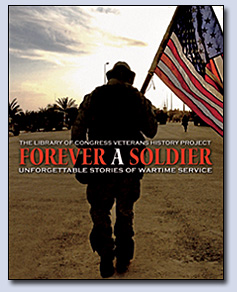
Forever a Soldier - Stories from the Veterans History Project


Drawn from the Library of Congress's Veterans History Project, Forever a Solider is a compendium of stories from on generation of soldiers on down the long gray line and more.

The editors have brilliantly organized the book into general topics with first-hand stories that include a few veterans of today's wars in Afghanistan and Iraq.


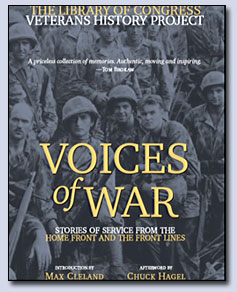
An earlier sister volume, Voices of War, chronicles over sixty veterans stories and has a similar, brilliant organization.

On homecoming:
“Strangely, my sympathy was quickly going to our former enemy, the German civilians.” –William Whiting

Saturday, November 11, 2006

At Dawn's Early Light - Can you See the Flag Clearly?

A "WAR" WE COULDN'T LOSE BACK THEN

Two years ago I wrote what I thought was an succinct and eloquent piece about the power of the tools that terrorists and insurgents and jihadis use. The context, at that time, was an Iraqi who had walked up to a marine and shot him at point blank range, very nearly. This type of thing sows mistrust between the populace and those trying to protect it. It highlights the information asymmetries of an army policing a population without a local knowledge or system of identifying who is who among them.

IN THEIR OWN WORDS

Now a new book comes out with an outline of all of that and more, called "What Was Asked of Us", complied by journalist Trish Wood.


By turns inspiring and heartbreaking, What Was Asked of Us is a landmark book, the first time our troops in Iraq have been able to speak at length about their experiences. From the thrilling highs (a spectacular rush by the 3rd Infantry Division into Baghdad) to the devastating lows (an account of what it was like to be a soldier at Abu Ghraib, witnessing the abuse of prisoners), this book lets the troops speak for themselves. As a result, it offers the most emotionally powerful and revealing account of the war and is necessary reading for anyone who cares about our soldiers and our country.

OUR SONS TO WALK THROUGH FIRE

This book is a putative effort to keep faith with the troops.

Many (most?) feel their cause to be right and just, but many of them question that and have felt the brunt of fighting for an Iraqi populace that is frightened, confused, indifferent, and hostile, in certain cases.

There are huge non-financial costs to waging war, costs to the soul. These are exacerbated if veterans feel separated from their warring public or imperfect government.

WITNESSETH

So, support the troops by looking here, see what they did and honor them by learning enough about the conflict to make good a citizen's duty, an informed opinion.

Thursday, November 09, 2006

Election Year Rejects


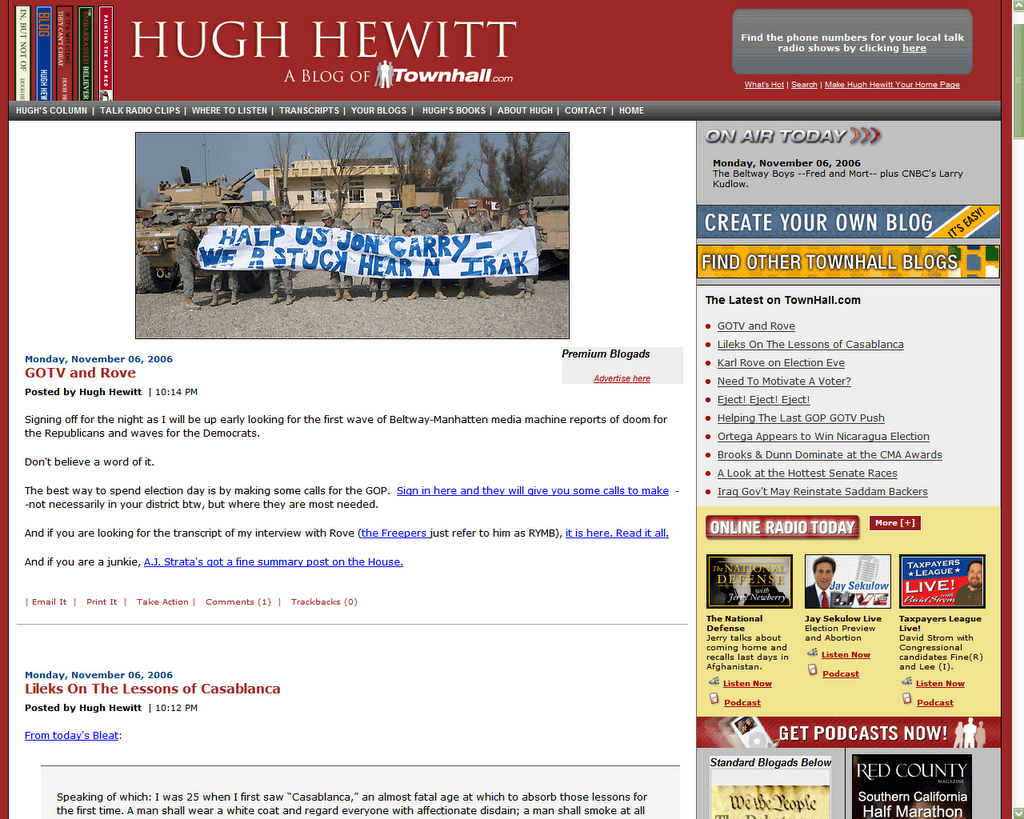
This repulsive blogging activity, pictured above, bears notice here.

Here we have eight soldiers (MN national guard 34th ID, 1st bridage), making a political statement in uniform. This unprofessionalism is a breakdown in discipline and a disgrace to the Army. (cf. DOD Directive 1344.10; Aug 2, 2004, which I assume is promulgated under the UCMJ).

One can only imagine the grave threat to the good order of the corps if other soldiers went down to the Baghdad morgue and sent back a photo with, "Correct, Mr. Cheney, the war is going 'Remarkably Well'. Hoo-Frickin'-Ahhhh....!"

Faced with a photo of this conduct disgraceful to the uniform, is it withdrawn? No. As you can see, it is proudly added to the permanent banner display and the publisher uses it recklessly to politicize the military. If one reads the type below, it actually solicits activities for a particular political party (and elsewhere, money too).

Who is boldly holding up this unprofessional and probably illegal behavior, even after it having been pointed out in the writings as such? A pundit? A loudmouth? No, it is a Professor of Law.

Such Professor, in one column, further suggests:


"Whether or not the old media carries the picture on front pages today (which would have been an obvious decision in any newsroom not deeply biased against the military and in favor of Democrats)" -Nov 2, 2006.


Such drastic indictment begs the question whether the publishers of this photo, Townhall.com (self-reported offshoot of The Heritage Foundation), took anytime themselves to get permission to use the photo, determine who was in it, determine if it is authentic, and consider the implications of further politicizing such activity, before allowing one of their own to abet such misdirected behavior while proclaiming themselves as civilian defenders of the military only in order to trump up support for their political party.

All these actions are surely no defense of the military, but a threat to its good order; and the willful purveying of this photo cannot be understood as poorly formed 'good intentions', after the wrongfulness of it had been raised.

Thus, we have on hand more election year rejects.

THIS LITTLE UNDERSTOOD WAR

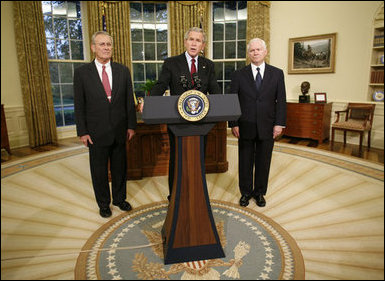
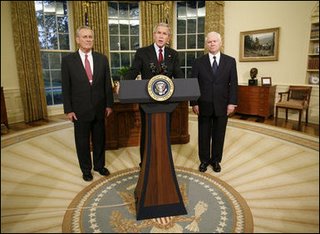
(White House photo: Paul Morse)

Rumsfeld's story will make a fascinating book one day. He is a complex individual who has had an enviable array of experience that he has pulled off with a character all his own.

Accordingly, there is so much to write, I'll confine comments to the following questions and observations.

WHY NOW?

This swiftness of Rumsfeld's departure caught me by surprise, as I had been thinking if it were to come it would be after the Baker report, not before. However, the timing suggests that the President was prepared for the shift that occured in the elections; and he acted quickly in order to keep the initiative on his side, to avoid looking pushed around later on, to keep the opposition from being able to leave its own imprimatur on an effort that the President, IMO, expects will yet turn out well.

Perhaps the President was also influenced by the hard-hitting exchange between the DOD leadership and the "chorus of criticism".

ARE WE SCAPEGOATING RUMSFELD?

To answer that we have to know what Rumsfeld did wrong, to know whether he is being held falsely accountable.

The Army Times's editorial lays out its case that Rumsfeld had lost credibility with the military because of a welling up of misgivings about the war that threatened dangerously to spill over:

"Active-duty military leaders are starting to voice misgivings about the war’s planning, execution and dimming prospects for success."

and


"And although the blame for our failures in Iraq rests with the secretary, it will be the troops who bear its brunt. "

In a hard hitting reply, the DOD (perhaps Rumsfeld himself), laid out the counter-case, suggesting that the basis of the criticisms was water under the bridge, not newly soured milk on any topic. It's a hunch that the President was not comfortable with this frank exchange of views.


The time to settle credibility problems was in the 2004 election, quite arguably, when the WMD failure ought to have been politically adjudicated and those who had clear problems with the conceptualization of what could be achieved in Iraq, in either the short-term or the mid-term or within projected cost, ought to have carried the day. As it was, the "truth" of the SmearboatVets prevailed instead.


On that accounting, We The People are guilty and the Congress is guilty as well for having ceded such authority as they did, without seeing to it that the war was robustly planned, given the lack of a margin for error.


Firing Rumsfeld now, which is really just code for firing the President himself as the two are so closely allied on principles, is a collective mea culpa; and an amazing display of how inconsistency (irrationality?) in democracies can actually turn a ship upright. So, in the larger picture, Rumsfeld's departure is a kind of expiation of all our collective failure. This, however, will not assuage his own sense of having been unjustly turned on, I suspect, except if he comes to accept that it was useful to protect the military from blame, as the ATimes article concludes.


THIS LITTLE UNDERSTOOD WAR


I will miss Rumsfeld's ability to encapsulate an issue in just a few words ("Rummyspeak"), a product of his wonderful intellect and now part of our national heritage, thankfully.


In the Oval Office, he talked about how the war was little understood and complex. He may have meant that as a defense, in the sense that circumstances post 2001 had required action in advance of comprehensive thought or that action had been taken with the best understanding that was available at the time.


However, it is more instructive as a comment on the current problems and some of his own failings. If folks are uneducated about "the war", perhaps he shares some blame, because his political instincts, seems to me from afar, are to hold information (classified or otherwise), until such time as his opponents need to 'take an education', as it were, usually at their expense. Rumsfeld is a politician and not a professor in that respect. And his skills and discipline are formidable.


Perhaps this is where Gates will do better. Armed with the work that is coming out of the Iraq Study Group (via Jim Baker et. al.), work that ought to have been done as part of the State Department's 2002 Project for a Future Iraq, Gates may have a chance to adopt a different posture and close what daylight there is. And judging by the Pentagon's latest effort to get the word out (For the Record), there is plenty.
Tuesday, November 07, 2006

Footnotes to the Absurd ...

Just to show how wide the gap is between what is being thought and what is being taught, I'll mention this tidbit.

Ken Mehlman, RNC power ranger, offered up a new focus of pre-emptive war or preventive war (paraphrase): "There is a goal out there and the goal is to prevent Iraq from becoming another Afghanistan."

Now, it's probably a bit unfair to single out this comment when so many are flying about that are equally eye-popping, but just take a moment to soak that one up, if you will.

It was also a good week for Counterinsurgency

THE BATTLESHIP IS TURNING

Counterinsurgency was the coin of the realm at the Cato Institute, in a panel discussion of where the military is on The U.S. Military and Counterinsurgency: What We Have Learned in Iraq and Afghanistan.

The current state of the aggregate knowledge about counterinsurgency matters more in prospect than does the retrospect, and focusing only on retrospect would likely require re-titling the panel, "What we wished we might have inculcated sooner" and, to some extent, "How the costs were mis-estimated by this generations' best and brightest" (somewhere in the room was the ghost of Robert McNamara, it seems).

Now that the Army is closer to sure footing, there is a chance that they can be more rigorous about self-evaluation. One potential issue, not explored, is the impact that thin troop levels may have had on willingness to be self-critical, in certain ways.

The hard question about whether anything much now is too little too late is probably too hard to answer, from afar. The ultimate question about whether the Iraqi populace's increasing anxiety - fears are rising as fast as hopes, it seems to me - hangs in the balance, with new Iraqi governments willingness to cooperate sufficiently on all aspects of counterinsurgency dangling in a way that could tip the scales.

AMERICA'S TOTAL READINESS ON TRIAL

In a crafty piece of writing, The American Way of War: Cultural Barriers to Successful Counterinsurgency, Jeffrey Record of the Air War College (Alabama) fleshes out a nuanced version of why wars of attrition are not hard in general for liberal democracies, but hard in particular for America. Among the points:

"The American way of war is, as British strategist Colin S. Gray observes

  • apolitical - not focused on warfare or counterinsurgency as an extension of policy (or ideology).
  • impatient
  • ahistorical - unwilling to take serious or learn the lessons of the past (unlike Fawaz Gerges who puts a brilliant tenor on unable to understand how history is important and culturally important to non-Americans)
  • culturally ignorant
  • technology-infatuated - mostly in regard to arms
  • firepower-focused - a version of "cowboys with guns", rather than diplomats with a range of tools
  • profoundly conventional - the bureaucracy (and its personnel policies)
  • sensitive to casualties - (debated during the Q&A)"


THE END OF THE WEINBERGER-POWELL DOCTRINE


The question is roundaboutly raised about what we can conclude so far about "military transformation", based on new data.

In the old world, if one "really read the Weinberger-Powell doctrine, you wouldn't never use force unless our shores were being attacked."

Of course, the newer formulation is that the status-quo is more risky than action. But there is a twist to that: The strategic choice to try to get by with as small an army and effort as you possibly can. It seems to me that any strong empirical conclusions about pre-emptive war, or wars against the status quo, are not possible without reference to that Bush-43 choice.

That choice, in turn, brings up the issue of cost, as Preble points out, or, more precisely cost-benefit. How it came to pass that President Bush (and the U.S. Congress and the US Press) put so little thought into how it might go wrong and end up with costs perhaps outreaching benefits is the key institutional failure, in my humble opinion. When there is little or no margin for error, when it is clear that there is going to be a race for control on the ground by forces seeking their own political autonomy (legitimately or illegitimately), the Rumsfeldian "known-unknowns" have to take a much higher priority than they were given.

MISSION OBJECTIVES UNCLEAR?

Last, mission objectives, like 'set the conditions for democracy to emerge', come into debate as the incompletely specified set that I suspect that they were intended to be all along.

Ricks questions how much specific actions are more "revolutionary" (deep change from the status quo) in character than "stability operations" (which require a reference to 'something politically stable' to be meaningful, i.e. a "thing" that may not exist or, if it does, may be inimical to institutionalization).

And the jury is still out whether throwing a nation into a quasi-Hobsian state-of-nature and then expecting the military to pull a liberal democratic rabbit out of the hat using counterinsurgency methods and largely military staffing can be done.

Given that, is a scaled back objective of a democratic Iraq that is self-sustaining and an ally in the war on terror more reasonable (or a comedown from hubris?)? Perhaps. The only question is, over the mid-term, who is going to guarantee the sanctity of the ballot box? A standing US army in Iraq?

Saturday, November 04, 2006

It was a good week for Counterterrorism as a topic

MORE CONTENT, LESS 'GREAT MAN' OF POLITICS / 'GREAT DEFENDER'

The International Center for Terrorism Studies at the Potomac Institute for Policy Studies held a conference that was available via C-span (unfortunately it is not available for replay..arg!).

US Politicians are behind - far behind. This likely has to do with the wrong conceptual footing that was the gambit of the haplessly phrased "War on Terror" that has infected domestic politics since. As with any journey, if your first steps are in the wrong direction, it takes double the time and effort to re-do them.

Whatever the case, one can hardly imagine a US Senator today giving the kind of far-reaching and perspicacious speech given by The Honorable Gustavo Manuel de Aristegui y San Roman (Member of the Spanish Parliament and Spokesman in the Foreign Affairs Parliamentary Commission for the Popular Party). I haven't been able to find a transcript, but all we'd need is a few good Senators with this breadth of comprehension to get back on track.

Such speeches and comprehension start to pave the way for a transition from 'brain storming' about counterterrorism to crystallizing some worthwhile public diplomacy (I mean, almost anything to replace the "We're gonna win the war" rhetoric might be an improvement).

HOW TO GET THE GROOVE BACK

Brookings offered up a redux of the Politics of National Security. Those who are interested in an in-depth look at how politics-as-usual or politics of the unusual are denying the public interest, the common good, and arguably national security itself can peruse a transcript.

Wednesday, November 01, 2006

Stepping up to Step Down by Fareed Zakaria

Zakaria has started to flesh out what I will call a "stand aside" exit strategy from Iraq, by redfining the goals there. His article is here.

There is a lot to disagree with in his article, so I just want to focus on what I see as one key strategic point.

I wondered aloud in one of my comments whether the Shia groups were ready yet to "buy off" the Sunni insurgency, with money and temporary political advantages that might cover a strategic 'political transition period' of say 10 years, maybe 3-5 years for 'reconciliation commissions' and the like.

Zakaria has this to observe, to the contrary:

What is equally obvious is that such a deal does not seem to be at hand. The Shia leadership remains extremely resistant to any
concessions to its former Sunni overlords. The Shia politicians I met when in Baghdad, even the most urbane and educated, seemed dead set against sharing power in any real sense. In an interview with reuters last week, Prime Minister Nuri al-Maliki also said he believed that if Iraqi troops were left to their own devices, they could establish order in six months in Iraq.

Now, I think it would be worth testing the thesis that the Shia really do know how to bring order, and we can argue about whether it is by force or whether they really do have some ideas on how to 'buy off the Sunni insurgency' politically.

The point is that the Shia can think strategically too, even though they are fractious. From their perspective, by already having political majority and also a more organized set of 'official' and 'unofficial' troops, to date, it is the US that is their strategic concern, arguably, not the Sunni. They might be concerned, for instance, that the US will do something like disarm them, or worse, turn back the clock on the gains that they have consolidated so far. This is why the focus on disarming the Shia militias by Baker et al., while completely rational based on experiences such as Lebanon, is a non-starter politiclaly with the Shia.

Their appropriate strategic move is to keep the status quo. The Sunni violence works to weaken the US as does time. Later on, they can make a pact with the Sunni, maybe in six months, as suggested.

In sum, the observation that even the most erudite Shia are against settling, that the opinion is so univocal, may not be related to sectarian animosity. It may be that it is so plain to everyone that continuing to drag the US along is the best strategy to weaken their main strategic opponent, the US.

We'll see if that is too much of a bad-faith characterization. The U.S. says it has worked on benchmarks with the new government, but Rummy insists from the DoD podium that their are no penalties contemplated for missing them. Is that too tempting a blank check? I suspect so.

Of course, they could get the US out by making a gambit on the Sunni insurgency now, but one wonders if they are spiteful enough to deny the US (Bush?) a 'victory' of that kind. I suspect the odds are at least 50/50.

History catching up with GOP: Newsweek publishes list of must reads

I had been making my own list; but, some people are getting paid to do that!

Newsweek online has published a list of what they call 'must-read' books on what has really happened in Iraq, so far.

My two-cents is that this list is probably too long for most people. To be an informed citizen, my guess would be some competence in understanding radical Islam, some competence in understanding terrorism (political violence) and counterterrorism strategies, and some complex combination of mistakes made (missed opportunities), regional politics, and projection of upcoming choices.

Anyway, here is the list in title form:

  • The End of Iraq: How American Incompetence Created a War Without End by Peter W. Galbraith (Simon & Schuster)
  • Fiasco: The American Military Adventure in Iraq by Thomas E. Ricks (Penguin) Generation Kill by Evan Wright (Putnam)
  • My War: Killing Time in Iraq by Colby Buzzell (Putnam)
  • Cobra II: The Inside Story of the Invasion and Occupation of Iraq by Michael R. Gordon and Bernard E. Trainor (Pantheon)
  • The Assassins’ Gate: America in Iraq by George Packer (Farrar, Straus & Giroux)
  • The One Percent Doctrine by Ron Suskind (Simon & Schuster)
  • State of Denial: Bush at War Part III by Bob Woodward (Simon & Schuster)
  • Hubris: The Inside Story of Spin, Scandal and the Selling of the Iraq War by Michael Isikoff and David Corn (Crown)
  • Imperial Life in the Emerald City: Inside Iraq’s Green Zone by Rajiv Chandrasekaran (Knopf)
  • The Prince of the Marshes: And Other Occupational Hazards of a Year in Iraq by Rory Stewart (Harcourt)
  • Overthrow: America’s Century of Regime Change from Hawaii to Iraq by Stephen Kinzer (Times Books)
  • Blood Money: Wasted Billions, Lost Lives and Corporate Greed in Iraq by T. Christian Miller (Little, Brown)
  • Baghdad Burning: Girl Blog from Iraq by Riverbend (Feminist Press at CUNY) The Foreigner’s Gift: The Americans, the Arabs and the Iraqis in Iraq by Fouad Ajami (Free Press)
  • The Shia Revival: How Conflicts Within Islam Will Shape the Future by Vali Nasr (Norton)
  • Night Draws Near by Anthony Shadid (Holt)

Friday, October 20, 2006

Getting smart about tribunals: separating power grab from counterterrorism-inspired judicial processes

I am not a legal scholar and it is often hard for me to be able to follow the discussions about what is happening to the Republic. Maybe others feel the same.

I have these questions, though, that I list just to see if anyone else has the same or can say whether these are off-base. As I find resources or formulate answers, I will add them to the thread.

  1. What is the role of Military Justice?

    This question came to my mind in the context of Executive authority. Senator L. Graham, on the Senate floor, said that he believes that, in times of war, the Executive ought to have deference in determining who is an enemy combatant, rather than a judge. This history of this principle, as I understood it, is so that the military can shape the battlefield to its advantage.

    My question, however, is what is “the battlefield” in international terrorism, except the streets and houses of non-US citizens? Do we really want the military ‘shaping’ this part of our international relations, in general?

    We fought international terrorism for a long while before 9-11 (and it seems other nations, like Britain have too). What has changed since then? We have mobilized the Army (for Afghanistan). Well, is that just a circumstance or do we really need new legal principles for that, a mobilization which we do not expect to be frequently recurring?

    Last, why is the military the right choice? I can appreciate the difficulties of offering criminal trials, but what is the argument against having a civilian tribunal set-up, rather than a military one?

    Lindsey Graham was asking, “Do you believe 9-11 was an act of war or a crime?” (asked of Justice Alito, too).I think most sensitive, non-lawyer folks believe that terrorists acts are “acts of war (or moral depravity) that we intuitively feel should be calmly and steadfastly prosecuted as crimes.” Can the legal system be made to accommodate that tension?

  2. What is a successful trial for international terrorists?

    This question came up in watching Mary Jo White, et. al. on C-span yesterday.

    How can we possibly NOT think of a trial as an extension of our counterterrorism efforts? Clearly, al-qa’ida types believe that their trial is just the ‘judicial phase’ of their jihad, their public platform even to show the political part of their political-violence.

    It seems to me that ‘success’ goes beyond proving ‘guilt’ in a conspiracy, for example. We might define the public interest in paying for a trial, for Justice, to publicly re-enforce a broad-reaching counter-terror strategy, viz. that political violence is the wrong choice for social change, that individual pain or suffering does not justify all things to oneself, that terrorist acts are not moral championship but moral abdication, etc.

  3. Should we look to specific cases to make good judgments about how to handle them or do we need a complete “framework”?

    How much are decisions about what to do being and proposed solutions driven by the number of new cases, how much by the similarity of cases, and how much by the uniqueness of cases?

    Are we making choices about how to structure due process because we do not have “good cases” or have “poor cases” against certain people who we just do not want to let go (let go at any price)?

    Are we ready, as a public, to actually let someone go, because a confession was the result of CIA …er .. “righteousness”, rather than regress the evidentiary rules so much that even hearsay is ‘sufficient’ or worse?

  4. How much do we need harmonize international approaches to prosecuting terrorists?

    How much can the World’s Security Net be set-up so that there are some minimum standards of evidence and perception that serving Justice to terrorists is not something that is so wholly dependent on jurisdiction?Rather than take differences as something that ‘must be dealt with at trial’, how much do we need to deal with it at the diplomatic and ex ante security arrangement level?

    Should we view our legal system as spoke in the wheel of the legal systems of many cooperating Nations?

    What is a good relationship between counterterrorism/enforcement and judicial prosecution? Are we interested in intelligence value, primarily, that is, in being integrated into an capture/interrogation process? Can home countries try terrorists? Does the dependence on proprietary intelligence sources make that an impossibility?

  5. How much and how should ‘fault tolerance’ be included in the design of legal choices?

    Are there unique implications for counterterrorism of Type-I and Type-II judicial errors and prosecution ‘failure’? Are these unique implications such ('stakes so high') that they change the character of the Justice we seek?

    Can we or should we tolerate certain types of errors more than others?

    If so, what are the costs attached to each? Who gets to choose how to balance that equation, to make that choice – the courts or the legislatures or the executive?

Straight talk on "Strategy" Generates Administration Accountability

"Accountability" is in the air in Washington, at least in prospect.

A TEMPLATE FOR ACCOUNTABILITY AND CITIZEN-LED EVALUATION

One way forward is to start insisting in clear thinking. Not just smart-talk about counterterrorism, but also demand that the Administration (especially Scty Rumsfeld and the DoD Press Corps) clearly separate goals from strategy, and that they be fully accountable for the strategy -- for clearly articulating it, responsibly communicating it, and for sharing evaluations of it.

Some tactical choices may prove insufficient to an adopted strategy. This doesn't negate the strategy, per se. However, if there are no or few tactics that can be or have been used to execute the strategy, then the strategy may not be executable or adoptable. Something else is needed.

STRATEGIC EVALUATION

If the results of a strategy turn out to be insufficiently complete or show themselves too costly (measured in time or treasure or both), and if there are indications that other factors that make the effectiveness of a strategy remote or increasingly remote, then the achiveability of the stated goals starts to come into question.

SAMPLES

These are examples of goals (and they can be disputed):

  • Neutralize the insurgency (Woodward quotes Rumsfeld)
  • An Iraq that can defend and sustain itself and be an ally in the "War on terror" (not my phrase). (Bush in Stephanopolous interview)
These are slogans, mostly useless (boo! ug!):
  • Stay the course
  • Cut and Run
  • Until the job is finished
  • Peace with Dignity
  • The Only Exit Strategy is Victory

Here is one counter-insurgency strategy: CLEAR-HOLD-BUILD ( clear /limit each area of those with hostile intent and capability; hold ground against backsliding; and build out political, security, and infrastructure until overall objective is achieved).

Within the strategy there could be various tactics:
  • Perimiter operations, US only troops
  • Police training, Army involvement (US, Iraqi, other national)
  • Psy-ops
  • Political negotiations/bargaining - even payoffs for information and cooperation
  • Support from Scorpion Brigades

Trust Me, the Iraqi ‘War’ is Going as Well as Expected

SAY WHAAAAT?

`We are making progress everyday in Iraq', is what we heard this week and last from the WH press secretary and from the DOD podium.

Do you feel like you have enough information to know whether OIF (Operation Iraqi Freedom) is going well or not? I don't.

I'm talking about decision-quality information.

By that, I mean sufficiently comprehensive, systematic, accurate information, not just ad-hoc reporting of this particular area of sectarian violence, this-or-that town, or the latest backward-looking body count?

YOU HAVE TO KNOW WHAT YOU WANT TO GET IT

It is time to start challenging the notion that the remainder of this struggle in Iraq needs to be classified "secret" in order to win it. I've put together a potential starting point at the end of this post for what I have in mind. Everyone should consider what is on their own list, however. This is not dogma!


Here is what I want from my government, for the sake of my Army and for the sake of a government by The People, not by The Experts. I hope you do was well.

REQUIRED WAR REPORT OF THE PRESIDENT, bi-weekly

OIF Strategy: CLEAR - HOLD - BUILD

PROGRESS REPORTING, Percent completed

  • Five metrics of progress for each segment of "Clear", "Hold" and "Build".
  • An overall % completed guesstimate
  • Breakdown for each Province, 18 in all. Breakdown by other, smaller groups (by sheik, by jurisdiction, by sharia court if one has been set up for a local area, by any group with significant influence in an area).
  • Requested field resourcing.
  • Breakdown of the assessment of what materials, equipment, and political support are needed at each stage, for example:

    CLEAR - troop levels and skills unique to `Clear', weaponry, intelligence, time-phased troop levels and skills, required Iraqi expertise (troop levels, cooperation/coordination, equipment, etc.); Foreign cooperation and expertise;

    HOLD - troop levels and skills and levels unique to `Hold', buildup of army forces, alliances, political certainty on issues, Iraqi expertise (build-out of army and police units, vertical and horizontal political consolidation of power/influence, short-term economic improvements); Foreign support (material and nonmaterial);

    BUILD - troop levels and skills, maintenance of political alliances/cooperation, electricity, water, all things USAID; U.N.

ORGANIZATIONAL DESIGN IN THE MILITARY

  1. A disclosure on the what personnel design strategy has been chosen to ensure that cross-functional teams that are meant to solve the problems that are known to exits at each stage of clear-hold-build. Some of these tasks require long-term commitments; others, short-term.

    This may imply different incentives, longer tours and commitments for advisers, different training needs - the list is very, very long.

  2. We ought to significantly challenge the notion that all coordinated effort (and information) be limited to the military chain of command, Period.

    This may involve a redefinition of the unit level to include civilians of one type or another, including State Department or USAID people or others who need to be part of competent, cross-functional teams.

  3. Metrics on the processing of requests and a top-Brass accountability `track' that ensures that important field-requests and information are not slipping through the cracks of the bureaucracy.

    This may mean that the military has to get more publicly `exposed' than they are used to in peacetime. If we need to elect one of their own in 2008 to get them to do, so be it.

REFOCUS THE OLD DEBATES IN A NEW LIGHT

We ought to be able to end or attenuate the exhausting debate about `troop levels' in this way.

Field-level raw requests for troops will give a bottom-up range, low to high, of the requested troop levels. How the Brass chooses to `modify 'those requests and the rational can also be laid bare. At least this decision process will finally be made plain enough that we can stop saying "trust me" and start arguing tactics, which may not result in agreement, but at least it will end radical doubt and maybe even create some buy-in.

INFORMED CONSENT OF THE GOVERNED

Without a fact-based sense of retreat or advance, a policy of `hope' cannot be sustained, even if aptly put. No amount of repeating the threats, the so-called lessons of 9-11, or harping on "the stakes" (that were not initially laid plain or made clear), is going to be ultimately sufficient.

During World War II, people knew of grave dangers, they knew when the Germans were advancing and when there was a battlefield retreat or difficulty. They had Roosevelt and Churchill to offer words to help keep the faith.

Today, instead, we have an amorphous war with threats of failure keeping us going rather than a calm, technical approach to counter-terrorism and counter-insurgency on which we can publically debate.

It is time to demand better for the Republic, don't you think?

Thursday, October 19, 2006

Carpe Diem.

This is a test.