Showing posts with label Wartime Politics. Show all posts

Friday, February 23, 2007

Struggle Inside Islam


One of the reasons that I had picked up Halliday's book that I was recently discussing here was to see if there were not insights into how to confront radical Islam that were mapped out by experts. Frankly, there has to be more than Reagan-style confrontation with the Soviets, which is the mud-track that some on the Right are stuck in, without any overt reflection about why that model is applicable, let alone best.
Unfortunately, that still has to wait.

Doesn't most every 'revolution' ultimately include some segment of its intitial supporters disillusioned over its ideals having got lost in translation

Anyway, Time Magazine's Baghdad bureau guy, Bobby Gosh, weighs in this week with a bleak cover story on the topic of Sunni-Shi confrontation.

WHY IS AMERICA TO BLAME FOR EVERYTHING, ONCE AGAIN?

His observation, on Charlie Rose show last night, that both sides are united in blaming the U.S. for the problem is remarkable. How it could come to pass that the U.S. should be blamed for a set of issues so far outside its control, almost without question or refutation, is testiment to how angry people are at America and possibly with their own hijacked revolutionary hopes for Iraq (as Halliday notes, doesn't most every 'revolution' ultimately include some segment of its intitial supporters disillusioned over its ideals having got lost in translation).

Tuesday, February 20, 2007

Neocons in History: Part II, A Clean Break ... Goes Bust

In a keen foreshadowing, Jim Lobe wrote a note in 2002 called, "Neoconservatives Consolidate Control over U.S. Mideast Policy", in opining about the rise in the Bush administration of Elliott Abrams:


Neoconservative hawks in the administration of President George W. Bush have won a major battle against the State Department in the fight for control of U.S. Mideast policy with the surprise appointment of Iran-Contra figure Elliott Abrams to the region's top policy spot in the National Security Council (NSC).

For the first time, someone who has publicly assailed the "land-for-peace" formula that has guided U.S. policy in the Arab-Israeli conflict since the 1967 war has been appointed to a top spot in Mideast policy.


Years later, we get the following numbers, which suggest that "Peace through Boldness", as Lobe shorthands it, has brought sentiment well past the point of constructive tension:


In a nutshell:
Egypt: favorable 13% unfavorable 73%
Jordan: favorable 5% unfavorable 90%
Lebanon: favorable 31% unfavorable 64%
Saudi Arabia: favorable 11% unfavorable 82%
UAE: favorable 35% unfavorable 61%

Among the most interesting figures, however, is that 45% said that being a Muslim was the most important part of their identity--more than the number who referred to their Arab or national identities. That's nearly double from the 2002 poll result.


That is about as bad a policy outcome as one could imagine, in a conflict in which military power is arguably secondary (or only an integral part of a wider whole) ...

UNABLE TO TALK, SHORT-TERM IS BLEAK, TOO

This bad news comes at a critical juncture for I/P policy, whether or how to continue to confront the Hammas, as recent talks have produced little forward motion, but plenty of pressure points (not all of neocon making, but also not looking like neo-con inpsired solutions will bring anything):

From Amman, limiting "provocations" and the primacy of negotiations, under even adverse circumstances:
Tuesday, February 20, 2007

His Majesty King Abdullah II called on the Israeli government to revive the peace process with the Palestinians and overcome obstacles that hinder the resumption of negotiations between the two sides in accordance with international legitimacy resolutions.

During a telephone conversation with the Israeli Prime Minister Ehud Olmert, His Majesty also urged Israel to stop "excavation work" near Al Aqsa Mosque, adding such acts threaten the Islamic holy sites in Jerusalem and contribute to increasing tension in the region. - Petra News Agency


From Israel, pre-conditions of negotiations (not even peace) and trust-building gestures:


Prime Minister Ehud Olmert demanded yesterday in talks with Palestinian Authority Chairman Mahmoud Abbas and U.S. Secretary of State Condoleezza Rice that the Palestinian unity government recognize Israel, renounce terror and accept previous Israeli-Palestinian agreements.

Olmert said Israel would reject alternatives to the three conditions that are meant to make the unity government appear acceptable in the eyes of the world. The conditions were first set by the Quartet, comprised of the United States, the European Union, the United Nations and Russia.

Israel will not have any contact with Palestinian figures who are considered moderates, such as finance minister-designate Salam Fayad, if they serve in a government that does not accept the Quartet's conditions, Olmert said. In the Jerusalem meeting, he rejected the suggestion that Israel negotiate with the Palestine Liberation Organization, headed by Abbas, thereby freeing Hamas of the requirement to recognize Israel.

Olmert also demanded that the Palestinian government release captive soldier Gilad Shalit, who was abducted near Gaza in June. He also wants the government to stop the arms-smuggling between the Sinai and the Gaza Strip and deploy forces in northern Gaza to prevent Qassam fire.

Olmert promised that Israel would maintain contact with Abbas, but [Olmert] said the relationship would be limited to two subjects: fighting terror in accordance with the first phase of the roadmap and making the daily lives of Palestinian civilians easier.- Haaretz

The Political Misfortune of I. Lewis "Scooter" Libby

Today will be closing arguments in the perjury case of VP Dick Cheney's former chief of staff, I. Lewis "Scooter" Libby, whose political fortunes changed forever when Robert Novak wrote his column on July 14, 2003. The taxpayers fortunes have changed some $1.4 million, not including the trials, according to the AP, and Libby has raised a fortune of more than $3 million in his legal defense fund.

The folks over at Firedoglake have been making hay that the old-platform media hasn't been up to the task of covering the trial, but I wandered for 20 minutes through their website, before I gave up in a sea of un-organized details (excellent source material for writing a book, but not for time-pressed information consumers. Bloggert David Corn offers more concise summaries, in my estimation. Extensive pre-trial background, well presented, here.)

Perhaps AH can ask them to put together a timeline and to write up what they hoped to find out but which wasn't shown at trial, whatever came up that was totally unexpected, and the general import of the behind-the-scenes spillover for readers interested in more than simple guilt or innocence of the charges? (One effort here, Libby Trial Dodges the Truth).

Bloggert Swopa, while complaining about old-platform reports, offers up an interesting conjecture that, to him, seems in plain sight to those following the details:


What I think the [Washington] Post and [TPM bloggert John Marshall] are trying to imply is that those calls [to six Washington journalists] from Air Force One were specifically orchestrated by Libby, based on Cheney's instructions on Air Force Two. And special prosecutor Patrick Fitzgerald has sources on both planes to back that theory up.
PARDON ME?

Few people have speculated in advance of a verdict about whether Libby may eventually get a pardon for any of his adjudicated transgressions, perhaps with some pulbic support out of pity if folks come to understand that the true impetus for the Plame affair originated with his bosses. At least one neocon, Elliott Abrams, who pleaded guilty to lying to Congress as a diplomat in Reagan's State Department, had their political careers resuscitated. Abrams was pardoned by Bush-41 and, after a series of very critical posts with Bush-43, became a Deputy National Security Adviser, a post he still holds.

CLEMENCY FOR FRIENDS, PENALTIES FOR FOES

Against this backdrop, one starts to see the injustice, the duplicity, in the GOP's strategy for handling leaks and leakers.

On the one hand, it is fairly clear to an outside observer, that the Attorney General has been set to the task of providing a penalty to those who leak information. Leaking itself is neither good or bad, but the person who leaks must face consequences.

The imputed policy of imposing costs on a leaker can be gleaned from a number of instances:

  1. the robust prosecution of the investigative journalists who used leaked grand jury testimony in the baseball steroid scandal


  2. the partial, rather than full, de-classification of the deeply embarrassing NIE of April 2006 on Iraq, so that the leaker could still be held accountable, presumably;


  3. the case of imposing a cost on Joe Wilson, albeit non-legal, for relying on a privileged position inside the government (his wife Valerie Plame's connection to the CIA) to provide information in an NYT op-Ed that others might have wanted to keep secret.

While we might think intuitively in terms of a "just leak", one that serves the public interest better than the elected officials are doing, there is, of course, no such legal category.

THE COUNTENANCE OF POOR GOVERNANCE

However, not only is the GOP's Administration in an odd position of having used 'leaks' to fight Wilson's 'leaks' (perceived as non-loyalty or policy-unfaithfulness, if not outright peddling of privileged information) but they also have promoted convicted liars right on up to the the highest ranks of government, namely the NSC.

It a hurdle to portray the first as anything more than vindictive and the second, hypocrisy.


(photo: AP)

Neocons in History - Black Eye for the New Century, So Far

I've been casting about to compose a post on the erstwhile Department of State's (DoS) "Future of Iraq" project, and I came across this reasonably well-known tidbit from the pages of neocon History. To be sure, it is to their credit that, unlike the White House's website on Saddam's "Apparatus of Lies" (painfully ironic in retrospect), they are brave enough to continue to show their history:


Such uncertainty will, by itself, have a seriously destabilizing effect on the entire Middle East. ...

In the near term, this means a willingness to undertake military action as diplomacy is clearly failing. ...

Although we are fully aware of the dangers and difficulties in implementing this policy, we believe the dangers of failing to do so are far greater.


Letter to President W. J. Clinton, January, 1998 - signed by:

Elliott AbramsRichard L. ArmitageWilliam J. Bennett
Jeffrey BergnerJohn BoltonPaula Dobriansky
Francis FukuyamaRobert KaganZalmay Khalilzad
William KristolRichard PerlePeter W. Rodman
Donald RumsfeldWilliam Schneider, Jr.Vin Weber
Paul WolfowitzR. James WoolseyRobert B. Zoellick

(shading = appointee of President G. W. Bush, some still "serving")

Sunday, February 18, 2007

Taking the Temperature: Newt Revisited

It often pays to revisit Newt Gingrich, from time to time, if only now because the current candidates for the GOP nomination are not likely to put forward any bold ideas (Romney is flogging tort-reform, for instance).

SOMETHING NEW OR JUST DRESSING UP

Newt has long been saying that the State Department is "broken", but it was recently before the Senate in testimony that he called for a huge investment in the State Department (without suggesting how it might be funded), as follows:

14. The State Department is too small, too undercapitalized and too untrained for the demands of the 21st century. There should be a 50% increase in the State Department budget and a profound rethinking of the culture and systems of the State Department so it can be an operationally effective system.
Now, just when you thought that a new Conservative belief in the merits of diplomacy was what was on his mind, he also comes up with the notion that diplomats ought to be subordinated in the military chain of command:

1. Place General Petreaus in charge of the Iraq campaign and establish that the Ambassador is operating in support of the military commander.
Also, if one grabs his speech from Herzliya (key Israeli defense conference), you come across this jab at the DoS:

The US should have as an explicit goal, regime change in Iran, as its constitution makes them a revolutionary regime. In 2006 even the Department of State which seeks to deny the nature of reality, noted that Iran is a leading sponsor of terror. What I need is something that will be similar to Reagan’s Replacement strategy in Iran. The current unrest in Iran will facilitate this.
So, it is also a change in policy viewpoint that Newt wants "up-funded" (which is my new diplo-military term, to keep faith with the spirit of the proposal).

Altogether, nothing new, just more spending, it appears, whereby the DoS becomes an elements in the DoD Chain of command ...

By the way, that is to be sharply contrasted with Senator J. Warner (wartime rubber stamp from Virginia), who was unabashedly questioning General Casey on how he and Ambassador Kalizad interacted in the field with the new Iraqi government and making the overt point of suggesting that the military might want to put the Ambassador in the lead, if only because questions may be coming down the road.

This is the new wartime posturing, whereby everyone is not in the same boat, or so it seems, but thinking about "blame time", just as they do inside large corporations.


GENERALS PREPPING THE LAST WAR

Sadly, parts of Newt's testimony look like generals trying to prep to win the last war: more troops, a radically revamped US AID office, "new metrics", a National Security Budget that is closer to historic highs than historic lows, and very, very clearly a "fix" for the "inter-agency process".

Two observations, at least, on that. One, a revamped US AID office suggests that the US is going to be in a long term "war" that involves ... nation building, yes? If not, than what? Two, how can General Petreaus hope to fix the inter-agency process? If it is clearly so necessary/paramount and so clearly outside the scope of what Petreaus can do singlehandedly, then why should this General succeed, except in spite of the inter-agency process, not by fixing it?

That question is a nice segue to the next point.

WHAT HAS THE CIC BEEN DOING ON A REGULAR BASIS

I found the organizational and process recommendations that Newt made to be startling, an indication that the CIC basically delegated the war to his minister at defense, Rumsfeld and ignored the signs, those little thought poems from Rumsfeld conveying that some problems might have required (or still require?) a "big rethink" so to speak, profound process and institutional re-alignment.

Here is what Newt had in mind:


2. [Petreaus] should report daily to the White House on anything significant which is not working or is needed.


3. Create a deputy chief of staff to the President and appoint a retired four star general or admiral to manage Iraq implementation for the Commander in Chief on a daily basis.

4. Establish that the second briefing (after the daily intelligence brief)the President will get every day is from his deputy chief of staff for Iraq implementation.

5. Establish a War Cabinet which will meet once a week to review metrics of implementation and resolve failures and enforce decisions. The President should chair the War Cabinet personally and his deputy chief of staff for Iraq implementation should prepare the agenda for the weekly review and meeting.

Which all begs the question of what decision making really looks like inside the wartime Bush White House, if these things are not currently going on. I assume that Newt might reasonably be expected to know that they are not.

PUSHING DECISION MAKING DOWN THE CHAIN ACTUALLY PUTS PRESSURE ON THE TOP

There are those who maintained that a single U.S. President could handle two major military engagements, a far flung fight against terrorism, the challenge of reshaping domestic homeland security, a re-election campaign and much else besides.

Even given processes that are optimally efficient, that's a LOT of activity to coordinate!

Saturday, February 17, 2007

Senate Confirms Role in Ongoing "Broken Branch" of US Government

The US Senate today confirmed its role in the Broken Branch of government by failing to pass a procedural step required to move on to floor debate of a no-confidence motion in President Bush's 5-year prosecution of Operation Iraqi Freedom.

GREGG'S AMENDMENT CALLS FOR CONGRESS TO WRONGLY CEDE POWER TO EXECUTIVE

Senator Judd Gregg, R-New Hampshire, is emerging as a chief spoiler for the GOP, offering amendments here and there that are designed to torpedo bills (cf. the line-item veto amendment that he recently offered). His amendment or alternative bill would have requested a vote that the Congress never pull funding from U.S. troops involved in the conflict.


The Congress ought not ever cede its authority to end a war in this way. Against the backdrop that the GOP dominated Congress has consistently ceded too much authority and trust to the Bush Administration over the course of the Iraqi deployment, following VP Cheney's "last throws" ad hoc assessments among others, a call for the Congress to once again vote away its authority to pull funding from any mission.

NO MORE LINCOLN-DOUGLASS DEBATES

Senator John McCain (R-Arizona) didn't even show up for the vote. This is emblematic of how debate really occurs in the US today.

Frankly, the Senate floor is too exposed politically. It's easier to regurgitate pre-hashed comments on Sunday morning shows, calling on "my fellow colleagues", rather than actually call on them in person on the Senate floor. It's easier to stick to your talking points, than to answer questions from across the isle. It's easier to read a statement than it is to make extemporaneous remarks that are worthy of consideration.

So broken is the tradition of debate, that Senator McCain was comfortable staying away from the floor on a question of such importance to the Nation, choosing instead to campaign from the relative safety of the podium, the carefully composed photo-op, and make pronouncements to talk-show hosts about what his position is.

GOP SENATORS FAIL TO SHOW CONFIDENCE

A down-vote on a no-confidence measure is a vote that confidence is justified or warranted. To defeat a no-confidence measure on a procedural motion, to shy away from a real vote, is hardly the way to show confidence in the President or in his Generals.

The fact that, even at this late date in the conflict, that elected officials are unwilling to let their precious careers be defined by the defining issue of the times is telling of just how much self-saving compliance and pushover rubber-stamping is still available from the days when the Senate was fully in GOP hands.

Thursday, February 15, 2007

Money News

The "budget race" continues .... er, not to be seen left not wanting for budget dollars:

item: Army, Marine Corps Short $5 Billion for New Armored Vehicles in FY-08
item: Navy Outlines $5.6 Billion in Unfunded Needs
item: SOCOM Requires Additional $391 Million in FY-08 For Body Armor, Weapons
item: Army Details $10.2 Billion in 'Unfunded Requirements' for 2008

item one-time bonus for re-up: Every Marine who re-enlists before Sept. 30 will get at least $10,000, including those who already re-enlisted this fiscal year, according to a Corps-wide message released Wednesday.

item build-up: The service is in the midst of adding 22,000 Marines to its ranks — about 5,000 leathernecks a year — by 2011, for a total of 202,000 Marines.

BUT ...

The number of waivers granted to Army recruits with criminal backgrounds has grown about 65 percent in the last three years, increasing to 8,129 in 2006 from 4,918 in 2003, Department of Defense records show.

While everyone focuses on other aspects of the OUSDF's 'policy shaping' of pre-war intelligence, here are the Comptrollers budget figures.

Saturday, February 03, 2007

Democracy, Form Not Substance

In his latest, Fareed Zakaria shows how the debate has changed from whether Democracy is compatible with Islam to whether Democracy, broadly put, can combat "old-world hatreds", as I call 'em. He also throws in corruption.

I suspect this could and will occupy political science PhDs and sociologist for a long while.

How does it come to pass that democratically elected governments do not trend away from corruption of the public interest?

How does it come to pass that a populace fails to elect a government that is responsible to the whole people, not just a portion of it?

Tracking Oil: Federalism, Revisited

Since the first days of the OIF, so many have had ideas about how Iraq should manage its oil revenues, to avoid the curse of oil in relation to economic and social development. It would be a hoot to re-read old WSJ articles, with the best economic thinking on the topic, now so hopelessly ... dated.

These days, everyone is simply hoping that the third in a line of governments will have some agreement - any agreement - in order to stop violent disagreement.

Condi Rice testfied recently that the 'oil agreement' was completed and just needed to be finalized. Here are the outline details of the draft law, reported to date:

  1. Revenue will be "shared" on a per capita basis. (for more on ambiguity of "sharing", see below)
  2. Contracts (for development/operation) may be signed regionally, but will reviewed centrally (this looks like an almost unworkable set-up to me).
Outstanding issues include
  1. how much oil revenue will go to the central government (a.k.a. the revenue sharing law);
  2. a charter for the new national oil company;
  3. the role of the oil ministry;
  4. the principles upon which the new commission could reject regionally negotiated contracts.
  5. whether the commission will require a simple majority vote or a two-thirds vote to reject a contract's terms.
KRG Statement
WaPo Analysis

And the politics is more vexing than ever:
For now, however, the oil sector is a mess. Since the first attack on a pipeline on June 1, 2003, it has been a struggle to keep oil flowing. Basic production equipment has been looted or destroyed. Many wells still are not working properly. And last year, the U.S. special inspector general for Iraq reconstruction complained that Iraq's oil ministry was not reporting on its budget and had spent "only a fraction" of money set aside for capital costs.

...

Placke, who was part of the Iraq Study Group, estimated that 200,000 barrels a day is siphoned from the main export line through southern Iraq, put on barges, and loaded onto tankers waiting in the Persian Gulf. What's left after discounts and bribes goes to militias or insurgent groups, he said.

In the south, some local Shia militia, clan or clerical groups are trying to claim the rights to some Iraqi fields and a voice in negotiating access for foreign companies. A stake in a billion-barrel field could be more important than a stake in the parliament or cabinet. Some experts worry that, as in Sudan, oil could contribute more to tearing the country apart than to uniting it.

...

While the debate continues, the Kurdistan Regional Government is pushing ahead.

Thursday, January 25, 2007

Hot from Iran: passive infared sensors

Kudos to Newsweek and its reporters Michael Isikoff and Mark Hosenball, for picking up the trail of the Iranian weapons trade.

Full story includes perspectives on how significant the number of super-IEDs might be; the porous divide between Sunni and Shia terror activities, possibly; information about staging posts inside Syria and Lebanon; and a chief Iranian spy in broad daylight in Baghdad ...

http://www.msnbc.msn.com/id/16795765/site/newsweek/

Friday, December 22, 2006

Bush appears to make 'show' out of Rumsfeld's firing, buys time...

That's the only thing that one can conclude, so far, from the series of events, from November to December's end, 2006. Why would you fire a SecDef in the middle of conflict, unless you had a sense that there was something better at hand?

FOREVER YOUNG

The whole "New Policy" meme is starting to look ridiculous. Abjectly so.

The Iraq Study Group was convened nine months ago, now. Hitler's entire campaign into Soviet Russia had its decisiveness judged in a matter of three or four months, practically speaking, if my memory of military history serves. How can it be that the CIC is still "studying" the problem? I'm all for time-outs for re-evaluation, but the NIE estimate from last April was that things would be getting worse - who had the contingency plan?

"STAY THE COURSE", STILL OPERATIVE

One cannot help but feel that stay-the-course is still operative, because Bush is either waiting for al-Malaki to prove himself as the right guy for Iraq on some unknown measure(s) or for facts on the ground to shift in his favor, somehow. Last, he may be waiting for the new Congress in order to stick-it-to-ém with some controversial proposal - who knows, it's hard to believe anything he says, any longer (for me).

'GENERIC NEED' FOR MORE TROOPS - WHAT THE HECK IS THAT!?

Last, but hardly least, the one bit that we are given, without any broader strategy revealed for aligning the government institutions in a grand way to combat and win the fight against extremism, is that the Marines need a larger permanent force-structure.

For more invasions?

I mean seriously, shouldn't one try to win the "war" that is in front of them, before worrying about the "harder choices" of the next generations? Good grief!

BACKGROUND:

President Bush's 'Stay the Course on Policy Change'
Nov 8th, Fires Rumsfeld
Nov 11th, Meets with Israeli PM Olmert
Nov 30th - Meets with Malaki
Dec 6th - Iraq Study group
Dec 11th - Meets with State Department Officials
Dec 12th - Meets with Iraqi VP Hashemi
Dec 13th - Meets with Pentagon Brass
- Quips, "I won't be rushed"
Dec 18th - Swears in Gates

Dec 20th - Announces that large Army is required

"Let me wait and gather all the recommendations from Bob Gates, from our military, from diplomats on the ground; I'm interested in the Iraqis' point of view; and then I'll report back to you as to whether or not I support a surge or not. Nice try."

THE PRESIDENT: Well, I haven't made up my mind yet about more troops. I'm [STILL?] listening to our commanders; I'm listening to the Joint Chiefs, of course; I'm listening to people in and out of government; I'm listening to the folks on the Baker-Hamilton commission about coming up with a strategy that helps us achieve our objective."


More Troops - generically, I mean:

Q Good morning, Mr. President. Your former Secretary of Defense, Donald Rumsfeld, advocated for a lighter, more agile military force. Have you now concluded that that approach was wrong?

THE PRESIDENT: No, I strongly support a lighter, agile army that can move quickly to meet the threats of the 21st century. I also supported his force posture review and recommendations to move forces out of previous bases that were there for the Soviet threat, for example, in Europe. So he's introduced some substantive changes to the Pentagon, and I support them strongly.

However, that doesn't necessarily preclude increasing end strength for the army and the Marines. And the reason why I'm inclined to believe this is a good idea is because I understand that we're going to be in a long struggle against radicals and extremists, and we must make sure that our military has the capability to stay in the fight for a long period of time. I'm not predicting any particular theater, but I am predicting that it's going to take a while for the ideology of liberty to finally triumph over the ideology of hate


Indian Treaty Room, Press Conference

UPDATE:
Dec 28th - Meets with National Security Staff
Jan 10th - Notifies Congressional Leaders, Meets with Press, National TV Speech, Falcon Brigade from 82nd Airborne arrives Baghdad following week

Bush appears to make 'show' out of Rumsfeld's firing, buys time...

That's the only thing that one can conclude, so far, from the series of events, from November to December's end, 2006. Why would you fire a SecDef in the middle of conflict, unless you had a sense that there was something better at hand?

FOREVER YOUNG

The whole "New Policy" meme is starting to look ridiculous. Abjectly so.

The Iraq Study Group was convened nine months ago, now. Hitler's entire campaign into Soviet Russia had its decisiveness judged in a matter of three or four months, practically speaking, if my memory of military history serves. How can it be that the CIC is still "studying" the problem? I'm all for time-outs for re-evaluation, but the NIE estimate from last April was that things would be getting worse - who had the contingency plan?

"STAY THE COURSE", STILL OPERATIVE

One cannot help but feel that stay-the-course is still operative, because Bush is either waiting for al-Malaki to prove himself as the right guy for Iraq on some unknown measure(s) or for facts on the ground to shift in his favor, somehow. Last, he may be waiting for the new Congress in order to stick-it-to-ém with some controversial proposal - who knows, it's hard to believe anything he says, any longer (for me).

'GENERIC NEED' FOR MORE TROOPS - WHAT THE HECK IS THAT!?

Last, but hardly least, the one bit that we are given, without any broader strategy revealed for aligning the government institutions in a grand way to combat and win the fight against extremism, is that the Marines need a larger permanent force-structure.

For more invasions?

I mean seriously, shouldn't one try to win the "war" that is in front of them, before worrying about the "harder choices" of the next generations? Good grief!

BACKGROUND:

President Bush's 'Stay the Course on Policy Change'
Nov 8th, Fires Rumsfeld
Nov 11th, Meets with Israeli PM Olmert
Nov 30th - Meets with Malaki
Dec 6th - Iraq Study group
Dec 11th - Meets with State Department Officials
Dec 12th - Meets with Iraqi VP Hashemi
Dec 13th - Meets with Pentagon Brass
- Quips, "I won't be rushed"
Dec 18th - Swears in Gates

Dec 20th - Announces that large Army is required

"Let me wait and gather all the recommendations from Bob Gates, from our military, from diplomats on the ground; I'm interested in the Iraqis' point of view; and then I'll report back to you as to whether or not I support a surge or not. Nice try."

THE PRESIDENT: Well, I haven't made up my mind yet about more troops. I'm [still?] listening to our commanders; I'm listening to the Joint Chiefs, of course; I'm listening to people in and out of government; I'm listening to the folks on the Baker-Hamilton commission about coming up with a strategy that helps us achieve our objective."


More Troops - generically, I mean:

Q Good morning, Mr. President. Your former Secretary of Defense, Donald Rumsfeld, advocated for a lighter, more agile military force. Have you now concluded that that approach was wrong?

THE PRESIDENT: No, I strongly support a lighter, agile army that can move quickly to meet the threats of the 21st century. I also supported his force posture review and recommendations to move forces out of previous bases that were there for the Soviet threat, for example, in Europe. So he's introduced some substantive changes to the Pentagon, and I support them strongly.

However, that doesn't necessarily preclude increasing end strength for the army and the Marines. And the reason why I'm inclined to believe this is a good idea is because I understand that we're going to be in a long struggle against radicals and extremists, and we must make sure that our military has the capability to stay in the fight for a long period of time. I'm not predicting any particular theater, but I am predicting that it's going to take a while for the ideology of liberty to finally triumph over the ideology of hate


Indian Treaty Room, Press Conference

Saturday, December 09, 2006

The Fallacy of "Emboldening Terrorists"

We want the people of Iraq to live in a free society. It's in our interests. In my judgment, if we were to leave before the job is done, it would only embolden terrorists, it would only embolden the extremists. It would dash the hopes of millions of people who want to live in a free society, just like the 12 million people who voted in the Iraqi election. They want to live in a free society. And we support this government, because the government understands it was elected by the people. And Prime Minister Maliki is working hard to overcome the many obstacles in the way to a peaceful Iraq, and we want to help him. - President Bush, al-Malki visit, 2006 11 30

I would like to argue that this judgement about emboldening the terrorists is partly misdirected, as much as those who wanted so passionately to "send the terrorists a message" after 9/11.

We may not be able to "win" every battle with terrorists. It may be arrogance to suggest that we can. Terrorist methods are powerful.

THE PSYCHOLOGY OF WARFARE

Managing psychology of warfare is important, even key sometimes. However, one has to be careful in elevating it to a strategic goal, rather than a tactic. For sure, to fight the perverse messages of 'global jihad', it is important to at least stand up for those values indicted and greatly jeopardized by the false 'religious' callings of militant jihad.

But, to shape strategic choices because of how they might impact the psychology of terrorists is either to plainly put tactics ahead of strategy (usually a poor choice, a confusion) or to get the wrong balance among strategic imperatives.

SOME PRESSURE CAN ALSO BE STAGED, TIMED OR SCALED, NOT JUST CONTINUOUS, MONOTONE

We might do better to think in terms of putting degrees of pressure on jihadi groups, from any number of angles, and in terms of choices or tactics that allow for our freedom of action, action that is not drawn into a straightjacket because of perceived psychological impacts.

Besides, what could be better than duping an enemy into a false sense of security, than "emboldening" them?

What is important is that, whatever gains they might try to consolidate from a cessation or tactics retreat, stand in continuous jeopardy of being pushed over or pushed back. We ought not to think of 'losing face' over the kinds of smart, tactical shifts that would make a time-phased strategy in certain circumstances smart.

MORE ON THE EFFORT TO CONFRONT RADICAL, MILITANT 'JIHAD'

There is a question about whether to continuously engage in the political debate that militant jihad puts forward, as well as any number of other messages or to attack annointed leaders, lest one confer a kind of legitimacy and free press to their aims.

Ideas are still forming on precisely what the appropriate countermeasures are at each stage of militant jihad, as it is envisioned by its own theorists.

One way is to apply "medicine" (choice countermeasures) in various doses and then to measure how they are working. This is how governments in the Arab world effectively work now, quite arguably - they make statements and wait to see how 'the Street" responds. ('The Street' is nothing more than the long-term educational challenge, the literacy problem/dimension, in some respects.)

WRONG TO WITHDRAW, RIGHT TO REPOSITION

Accordingly, I think that abject calls for withdrawal ought to be met with derision, except as part of a broder plan to reposition the pressure campaign.

It might be possible to fashion a long-term strategy to confront radical Islam by denying it its next steps, by picking an choosing which issues on which to engage insofar as they have direct impact on achieving the next goals of the jihad (I'm thinking of the three phases mentioned below, iman, hijrah, and then jihad).

If one worries that the removal of military pressure in one situation might lead to greater recruitment, one has to re-position against recruitment, suggesting that the 'withdrawal' is a way to trap new recruits, who will be confronted/captured shortly.

In sum, there ought to be a continuous engagement, in my view, a pressure campaign, and it can include periods of repositioning in which certain confrontations are conceded as no longer productive and for which we do not have to worry about 'emboldening' some enemy today, if that is just a set-up for them to be neutralized or marginalized tomorrow.

Thursday, December 07, 2006

Rummy Accepts Medal, Schedules Town Meeting, Farewell Set for 15th

Sec Def Donald Rumsfeld accepted the Union League's Gold Medal a week ago or so. According to Defenselink, Gates will assume responsibility on the 18th and Rummy's farewell party is the 15th.

One last chance to soak up Rummyspeak:


(AP Photo/Haraz N. Ghanbari)
In a surprise move, Sec Def Rumsfeld takes a ... quasi-victory lap, visiting troops in Iraq on Dec. 9th ...

Wednesday, November 29, 2006

Newt, Pre-empting the Iraqi Study Group

link - Newt takes up the Iraqi Study Group

1. Does the Commission Have a Vision for Success in the Larger War Against the Dictatorships and Fanatics Who Want to Destroy Us?

I think that few are left who do not realize that there is a larger struggle for legitimacy, or as Tony Blair has put it, "Whose values will lead into the 21st Century", but not many agree on what the implications of that are for tactics, duration, resourcing, involvement.

I would bet dollars that the Study Group will have recommendations on how to confront radical ideologies within Islam. However, they may end up too vague, like "adopt a comprehensive approach" or "adopt long-term strategies".

2. Does the Commission Recognize That the Second Campaign in Iraq Has Been a Failure?

Their staff may not be able to agree why it has been a defeat, even more so without a classified clearance, so it may not be productive to declare a defeat.

3. Does the Commission Recognize the Scale of Change We Will Need to Adopt to Be Effective in a World of Enemies Willing to Kill Themselves in Order to Kill Us? Learning to win requires much more than changes in the military. It requires changes in how our intelligence, diplomatic, information and economic institutions work.

It seems unlikely that there will not be a battery of bureaucratic recommendations and changes to institutionalization, many including taking the military out of the 'lead', if Newt is ready for that ...

4. Does the Commission Describe the Consequences of Defeat in Iraq?
What would the withdrawal of U.S. troops in Iraq look like?

The larger military question is whether so much matters. In a purest sense, there are no such thing as 'unacceptable consequences' - war is Hell. When you go to "war", you accept even the unintended consequences, the Pandora's box that it opens, yes?

All quagmires are political, not military. As such, the Iraqi campaign is on borrowed time, by many metrics.

5. Does the Commission Understand the Importance of Victory? Winning is key. Time is on the side of those seeking nuclear and biological weapons to use against the civilized world.

Yet, time is exactly what is required for the scale of transformation that is necessitated.

"Victory" is misstatement or a poor choice of words. The near-term goals are containment, the mid-term goals are pressure, and the long-term goals are attenuation. The more one thinks in terms of a decisive "victory" the LESS likely it becomes.

6. Does the Commission Define What It Means to Win, or Simply Find a Face-Saving Way to Lose? Winning is very definable. Can we protect our friends and hurt our enemies?

It seems contradictory to suggest that the second campaign was a defeat but to suggest that a third is possible to "win".

It would not be reasonable to calibrate goals beyond what the facts on the ground make possible.

What's more, it seems to me more robust to come up with a perspective in which all outcomes are covered by a set of goal statements, recognizing that a significant portion of the outcome is not in the control of the U.S., either in the hands of an Iraqi government or others.

7. Does the Commission Acknowledge That Winning Requires Thinking Regionally and Even Globally?

humm...

Well, Saudi Arabia is spending millions on a medium-term (3+year) project to seal its border electronically with Iraq.

Newt sounds like he is looking for military escalation here, with "direct confrontation" of Syria and Iran. Of course, if he means "Karine-A" type evidence, then he ought to say so. That kind of evidence could be used quite successfully in non-military ways.

8. Any Proposal to Ask Iran and Syria to Help Is a Sign of Defeat. Does the Commission Suggest This? Iran and Syria are the wolves in the region.

Any proposal? Even "enemies" can cooperate to prevent the plug from being pulled on them both ...

9. Does the Commission Believe We Can 'Do a Deal' With Iran? The clear effort by the Iranians to acquire nuclear weapons and Ahmadinejad's assertion that it is easy to imagine a time in the near future when the United States and Israel have both disappeared should be adequate proof that the Iranian dictatorship is the active enemy of America. Couple that with the fact that the Iranians lied to the International Atomic Energy Agency for 18 years while trying to develop a nuclear weapon. Either this is a dangerous regime we need to fundamentally change, or it is a reasonable regime with which we can deal.

Too much either/or thinking, here. Besides, what nation lives 'without enemies' in modern times?

Nuclear proliferation has to be put on a separate plate than other issues, and cannot be, as Newt suggests, a matter of 'friends and enemies', at least among nation-states.

The rest of the issues with Iran are more nettlesome and what are the options to doing deals or making agreements, really?


10. Does the Commission Believe We Are More Clever Than Our Enemies?
The al-Assad family has run Syria since 1971.

Well, Syria is needed for a settlement of the I/P issue, one way or the other ...

11. Does the Commission Recognize the Importance of Working With the Democratic Majorities on a Strategy for Victory? The Democratic victory in the 2006 election should not be used as an excuse to do the wrong thing. The Democrats are now confronting the responsibility and burden of power. Opposition to continuing the failed second campaign should not be translated into opposition to an American victory.

The burden of power? The burden of prior mistakes ...

The issue of a third-campaign is whether it meets its burden of proof, empirically, not ideologically. And that's how it ought to be.

Sunday, November 19, 2006

Is the Government Following its Own 'Strategy for Victory in Iraq'?

ABIZAID TESTIFIES BEFORE CONGRESS

General John P. Abizaid, the man with more stress in world than Atlas in the Old World, offered up a careful assessment of the current situation in Iraq.

Is there evidence that the Government is following its own announced Strategy for Victory? How do we get over the hump of whether more is needed before less is accepted, if we can? There are so many issues/questions to look at, I'll just confine to these two.

IS THERE A SHARP EYE ON THE CHOSEN STRATEGY AND TOOLS?

It is easy to lob criticisms from every direction imaginable at people who are trying to run with the ball, as much as we have relegated the military to do so, for this conflict, with a sort-of closed-door vision of what to do and how to do it.

Yet, we still have the basic document that is meant to be informing the public about what are the steps to getting to goal, the administrations National Strategy for Victory in Iraq.

That document calls for short-term, medium-term, and longer-term goals. We don't see any of the present status reporting broken out into those categories, even if people are thinking of it. We appear to continue, even at this late date, to be asking questions about what the administration lists as a 'short-term' goal, namely the standing up of Iraqi Security Forces.

I may have surely missed them, but I didn't see much discussion about whether long-term goals were being met in places that had more stability, like the North and the South.

THE NINA, THE PINTA, AND THE SANTA MARIA

To reach the proverbial New World, the National Strategy document breaks down three conceptual areas, with the following strategies:

Political Track: Isolate, Engage, and Build
Security Track: Clear, Hold, Build
Economic Track: Restore, Reform, Build

Elsewhere the document invokes 'expanding political participation'. In the details, one finds the assumptions on which this strategy is conditioned.

Ambassador Satterfield injects a new "three pillars" element, but this is not new to the overall position, just, perhaps, a new area of rhetorical emphasis.

NO 'STRATEGY' FOR SECTARIAN VIOLENCE?

The rise in sectarian violence isn't covered by the National Strategy document.

What appears to have happened is that the an urgent emphasis on 'reconciliation' in the Political Track, which has involved a re-work of the Bremer-era de-Ba'thification, has been legislated in conjunction with a new military emphasis on Baghdad in the Security Track, supplied by soldiers from some other effort.

The Ambassador notes the simulataneity of the equations for each track; however, he suggests that only from the safety of a secure situation can the right compromises be reached. Elsewhere, the General suggests that only faced with the need to provide for their own security will the Iraqis themselves stand-up, so that the US soldiers can stand down. Apparently, these two seemingly opposed positions are resolvable.

THE ECONOMIC TRACK

THE POLITICAL TRACK - MUNICIPAL ELECTIONS AMID 'CHAOS'

THE TROOP DEBATE

[to be continued after the show]

Thursday, November 16, 2006

Rumsfeld Posts His Resume on Web


There is a lot more to be written about and by Rumsfeld.

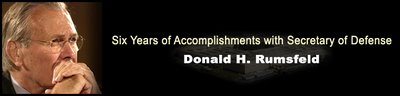
Donald-the-Liberator is not waiting, however. He's taken the time to list the most important things that occurred on his watch (see pic/link).

What was in his letter of caveats to Bush-43? Did he really want to turn Iraq over to the former Army and leave - if so, was he prepared to resign as a matter of conscience when it was clear that others wanted to prolong a U.S. stay? The list goes on. So much more yet to be told "For the Record".

Thursday, November 09, 2006

Election Year Rejects


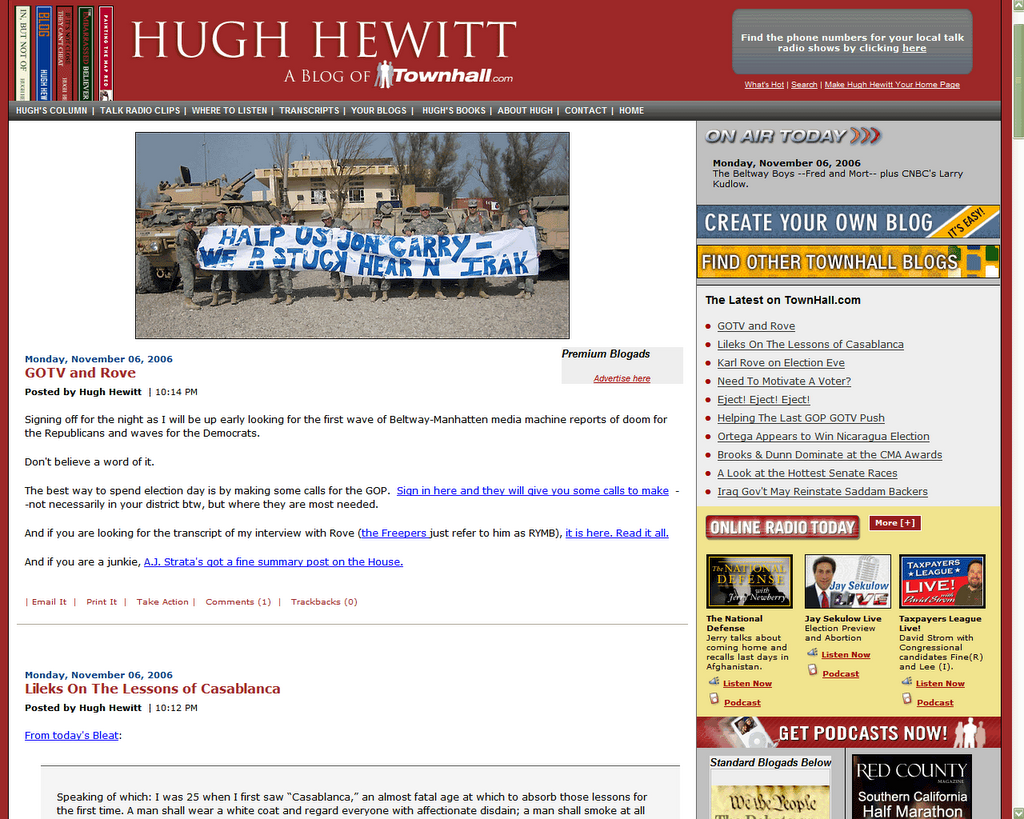
This repulsive blogging activity, pictured above, bears notice here.

Here we have eight soldiers (MN national guard 34th ID, 1st bridage), making a political statement in uniform. This unprofessionalism is a breakdown in discipline and a disgrace to the Army. (cf. DOD Directive 1344.10; Aug 2, 2004, which I assume is promulgated under the UCMJ).

One can only imagine the grave threat to the good order of the corps if other soldiers went down to the Baghdad morgue and sent back a photo with, "Correct, Mr. Cheney, the war is going 'Remarkably Well'. Hoo-Frickin'-Ahhhh....!"

Faced with a photo of this conduct disgraceful to the uniform, is it withdrawn? No. As you can see, it is proudly added to the permanent banner display and the publisher uses it recklessly to politicize the military. If one reads the type below, it actually solicits activities for a particular political party (and elsewhere, money too).

Who is boldly holding up this unprofessional and probably illegal behavior, even after it having been pointed out in the writings as such? A pundit? A loudmouth? No, it is a Professor of Law.

Such Professor, in one column, further suggests:


"Whether or not the old media carries the picture on front pages today (which would have been an obvious decision in any newsroom not deeply biased against the military and in favor of Democrats)" -Nov 2, 2006.


Such drastic indictment begs the question whether the publishers of this photo, Townhall.com (self-reported offshoot of The Heritage Foundation), took anytime themselves to get permission to use the photo, determine who was in it, determine if it is authentic, and consider the implications of further politicizing such activity, before allowing one of their own to abet such misdirected behavior while proclaiming themselves as civilian defenders of the military only in order to trump up support for their political party.

All these actions are surely no defense of the military, but a threat to its good order; and the willful purveying of this photo cannot be understood as poorly formed 'good intentions', after the wrongfulness of it had been raised.

Thus, we have on hand more election year rejects.

THIS LITTLE UNDERSTOOD WAR

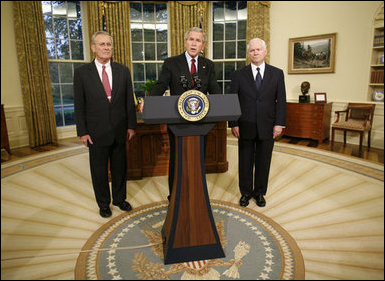
(White House photo: Paul Morse)

Rumsfeld's story will make a fascinating book one day. He is a complex individual who has had an enviable array of experience that he has pulled off with a character all his own.

Accordingly, there is so much to write, I'll confine comments to the following questions and observations.

WHY NOW?

This swiftness of Rumsfeld's departure caught me by surprise, as I had been thinking if it were to come it would be after the Baker report, not before. However, the timing suggests that the President was prepared for the shift that occured in the elections; and he acted quickly in order to keep the initiative on his side, to avoid looking pushed around later on, to keep the opposition from being able to leave its own imprimatur on an effort that the President, IMO, expects will yet turn out well.

Perhaps the President was also influenced by the hard-hitting exchange between the DOD leadership and the "chorus of criticism".

ARE WE SCAPEGOATING RUMSFELD?

To answer that we have to know what Rumsfeld did wrong, to know whether he is being held falsely accountable.

The Army Times's editorial lays out its case that Rumsfeld had lost credibility with the military because of a welling up of misgivings about the war that threatened dangerously to spill over:

"Active-duty military leaders are starting to voice misgivings about the war’s planning, execution and dimming prospects for success."

and


"And although the blame for our failures in Iraq rests with the secretary, it will be the troops who bear its brunt. "

In a hard hitting reply, the DOD (perhaps Rumsfeld himself), laid out the counter-case, suggesting that the basis of the criticisms was water under the bridge, not newly soured milk on any topic. It's a hunch that the President was not comfortable with this frank exchange of views.


The time to settle credibility problems was in the 2004 election, quite arguably, when the WMD failure ought to have been politically adjudicated and those who had clear problems with the conceptualization of what could be achieved in Iraq, in either the short-term or the mid-term or within projected cost, ought to have carried the day. As it was, the "truth" of the SmearboatVets prevailed instead.


On that accounting, We The People are guilty and the Congress is guilty as well for having ceded such authority as they did, without seeing to it that the war was robustly planned, given the lack of a margin for error.


Firing Rumsfeld now, which is really just code for firing the President himself as the two are so closely allied on principles, is a collective mea culpa; and an amazing display of how inconsistency (irrationality?) in democracies can actually turn a ship upright. So, in the larger picture, Rumsfeld's departure is a kind of expiation of all our collective failure. This, however, will not assuage his own sense of having been unjustly turned on, I suspect, except if he comes to accept that it was useful to protect the military from blame, as the ATimes article concludes.


THIS LITTLE UNDERSTOOD WAR


I will miss Rumsfeld's ability to encapsulate an issue in just a few words ("Rummyspeak"), a product of his wonderful intellect and now part of our national heritage, thankfully.


In the Oval Office, he talked about how the war was little understood and complex. He may have meant that as a defense, in the sense that circumstances post 2001 had required action in advance of comprehensive thought or that action had been taken with the best understanding that was available at the time.


However, it is more instructive as a comment on the current problems and some of his own failings. If folks are uneducated about "the war", perhaps he shares some blame, because his political instincts, seems to me from afar, are to hold information (classified or otherwise), until such time as his opponents need to 'take an education', as it were, usually at their expense. Rumsfeld is a politician and not a professor in that respect. And his skills and discipline are formidable.


Perhaps this is where Gates will do better. Armed with the work that is coming out of the Iraq Study Group (via Jim Baker et. al.), work that ought to have been done as part of the State Department's 2002 Project for a Future Iraq, Gates may have a chance to adopt a different posture and close what daylight there is. And judging by the Pentagon's latest effort to get the word out (For the Record), there is plenty.