Thursday, December 07, 2006

Syria weighs in, again, on Iraq

Vice President weighs in here, with Syrian perspective and demands that include a fixed timetable under the 'excuse' of fighting 'occupiers'.

In reference to a Syrian worry about a widening conflagration coming out of a deteriorating Iraq, he either directly calls the Baker-Hamilton bluff or opens public negotiations by mitigating it:

As for the notion of an international conference on Iraq, many European countries have recommended it to us. We support the formula but only if we know what the intended outcome of such a conference is. It has to have reasonable objectives that we can agree to work for.

We will not support just any political process in Iraq, we will support it only when it takes into account the interests of all the different groups in Iraq, when the Unity of the country is preserved, and when there is a time table for withdrawal (of US troops)

The US has failed terribly in Iraq. The Baker-Hamilton Report is an indication that the American people are waking up to the fact that they have been badly deceived by their government in Iraq. Some say that through dialogue with Syria and Iran, Iraq can be stabilized. We are not so arrogant as to believe that Syria can single-handedly solve the Iraq problem, which will have repercussions throughout the world. Perhaps not even all countries working together can help solve Iraq's problem, but it is incumbent on us to have the modesty to listen to each other and to try what we can.

We will not help any Iraqi leader who isn't against the occupation of Iraq or trying to end it. We told this to Allawi, to Jafari and to Maliki. We are against foreign occupation.

We do not expect much change in the American position. Some minor change, or a cosmetic change, or a tactical change. Although the public opinion in the United States is against the war, there are powerful groups in the US saying: "we will not leave empty handed after the 450 Billions we spent in Iraq." [translation thanks to Joshua Landis & friends

And on the re-emergence of Sharaa, this nugget in the early evolution of Syrian thinking on Iraq:

Sharaa also argued for the hard Syrian line on Iraq (Jihad) and resistance) in contrast to Khaddam. He probably believing that Saddam would put up more resistance than he did in opposing the American invasion. When this didn't happen and the US went on its Syria offensive, accusing Syria of aiding Iraq's Baathist deadeners, taking in Saddam's WMD, and opening a Ho Chi Min trail, Khaddam was given the Iraq portfolio. Khaddam tried to organize the Sunni tribal leaders in order to deliver them to the Americans and reopen a dialogue with Washington on the basis of delivering Iraqi Sunni cooperation for Lebanon. This strategy failed because Washington would not talk to its enemies, use diplomacy with the Syrians, or pay blackmail (whichever description you prefer). [Landis]


UPDATE: December 10th
al-jazeerah poll:

Will Hezbollah protests bring down the Lebanese government?

Yes : 44.2 % ; No : 38.7 % ; I don't know : 17.1 %

Number of pollers:12779

$1.3 million Report of Iraq Study Group


Below is a quick outline of the seventy-nine (79) recommendations of the Baker-Hamilton, Iraq Study Group Report.

Observations:


  • Parts of the document are not well organized. In particular, some of the last parts about Intelligence gathering, budgeting, and so forth should be in a section more aptly title, "Helping the U.S. to help itself, before helping Iraqis to help themselves".


  • There is a prima facie tension between injunctions to withdraw support, in favor of good behavior (diplomatic quid pro quo), and imperatives to help or assist, on certain things (like bolstering the judiciary, reforming the Interior Ministry, building Iraqi counter-terror investigative abilities).


  • The timeframe(s) carved out by the document are not always clear. Things like the wider regional conflict (the Arab-Israeli issues), perhaps parts of national reconciliation, and provincial (or municipal) elections are not going to be orchestrated in the short or mid term, most likely. Meanwhile, longer-term tasks are envisioned with U.S. support and participation, which may or may not occur, on the document's own calculus.


  • Apart from funding refugee relief (R66), the document makes no recommendations about what to do in the event that sectarian violence is not stalled, except that it does not recommend larger force structure imperatives, which might prove short-sighted in this other context.


  • For a hands-off Administrator or President, this is a daunting list ...

A SHIFT IN POLITICAL EMPHASIS, TACTICS

The document can be read as a shift in emphasis and politics, now that the Iraqis have a sovereign, central government, to putting the onus to Iraqi-led responsibility. Personally, I think that this shift ought to have been anticipated by the government in regular course and not required "fresh eyes". It's obvious that, as political control shifts, political positioning must shift to reflect a changed polity.

I believe, reading through the tea-leaves, the military has put its full support behind this shift, because they no longer want to be in Iraq a day more than necessary and have a sober view of the limits of their political influence (and, in some cases, their own dis-utility).

Still, cynics will read this necessary shift as a move toward blame-and-run. Whether it turns out that way will be a matter of watching what happens in the details, which is the only place that sincerity and good-faith can be judged, ultimately.

TOO MANY CRITICS, NOT ENOUGH ACTORS

One main thrust is that not enough people are working on Iraq, especially in the area of producing political reconciliation, forestalling catastrophe, and giving local combatants a larger local context in which to view their actions. Will 'more and diverse' attention attend resolution or just draw more parties into conflict? I suspect that risk is worth taking up.

THE RIGHT KIND OF EXTERNAL PRESSURE

Some things, like comments on the oil sector, look like sound external pressure for important change.

IF YOU DON'T LAUGH, ...

There was a bit of humor in the document, as well. In one section on setting milestones, it is noted that things that couldn't be done in 4Q06 should be done by 1Q07 (cf. R24). It is a bit ironic to be firm about milestones for others, but to be so generous with yourself.

IN THE BIG PICTURE

There is very little 'big picture' in the document. There are no sweeping recommendations or policy statements for combatting extremism, mid-term or longer-term, in the Muslim world (apart from the Arab-Israeli conflict and the nascent Persion-Israeli conflict). No view of what the US role is or what influence the US should seek to exert in the longer-term or how.

In some ways, this kind of 'big think' might be a distraction to getting some action on diplomatic efforts like an "Iraq Support Group". In the end, however, it may not be avoided, as it seems that the nation needs to come behind a common understanding of the threat and the short, mid, and long-term ways that the government is going to set about addressing that, which is the larger context for Iraq, to some extent.

Apart from language skills, not much on remaking the government's institutions to track an al-qa'ida threat longer-term.

Very little was given from a pure counter-insurgency perspective perspective, except a need to try to engage all groups politically.


MY SUMMARY OF RECOMMENDATIONS


  1. The External Approach


    1. The New Diplomatic Offensive


        R1: The offensive
        R2: Goals of the offsensive
        R3: Meeting in Baghdad of OIC or Arab League

      The International Support Group


        R4: Create ‘Tool’ of Iraq Group,
        R5: Members of the ISG among neighbors, Arab League, 5 UNSC, the EU, others (S. Korea)
        R6: Who should lead group: President or Sec of State
        R7: Call on the U.N. and a U.N. Special Envoy
        R8: ISG to tailor approaches to specific neighbors needs

      Dealing with Syria and Iran


        R9: Via ISG, engage Iran/Syria, using incentives and disincentives
        “Although Iran sees as in its interest to have the US bogged down in Iraq, …”
        R10: Iran’s nuclear program to be dealt with via UNSC, still
        R11: ISG influence Iran


          i. “Iran should stem the flow of equipment, technology, and training to any group resorting to violence in Iraq.”
          ii. “Iran should make clear its support for the territorial integrity of Iraq as a unified State, as well as respect for the sovereignty of Iraq and its government.”
          iii. “Iran can use its influence, especially over Shia groups in Iraq, to encourage national reconciliation.”
          iv. “Iran can also, in the right circumstances, help in the economic reconstruction of Iraq.”

        R12: US and ISG to “encourage and persuade” Syria


          i. “Syria can control its border with Iraq to the maximum extent possible…”
          ii. Establish hotlines to exchange information with the Iraqis
          iii. Increase political and economic cooperation with Iraq

      The Wider Regional Context


        “The US does its ally Israel no favors in avoiding direct involvement to solve the Arab-Israeli conflict. For several reasons, we should act boldly.” p. 54
        R13: A “renewed and sustained commitment” to A-I conflict on all “fronts”.
        R14: Talks on two tracks, Syria/Lebanon, Palestinians (“who recognize Israel”)
        R15 The Elements of a negotiated peace with Syria, enumerated
        R16: Israelis should return the Golan, with U.S. Security Guarantee …
        R17: The Elements of a negotiated peace with the Palestinians, enumerated
        R18 Political, Economic, and Military support for Afghanistan


  2. The Internal Approaches


    1. Performance on Milestones


        R19: Close contacts with Iraqis with “a message” of meeting milestones; public diplomacy effort to keep all relevant publics apprised.
        R20: Quid pro quo: For progress in National reconciliation, security, governance, the US can make clear its continuance of efforts to train, equip, and build.
        R21: Quid pro quo: Without progress, withdraw support
        R22: President should “make clear” (to whom?, how?) that US does not seek permanent bases in Iraq
        R23: President should “restate” that US does not seek to control Iraqi Oil

      Milestones for Iraq


        i. National Reconciliation related, p. 62
        ii. Security, p. 63
        iii. Governance, p. 63
        R24: 1Q07 for anything that cannot be done in 4Q06 [!!!]
        R25: Work with Iraqis to develop additional milestones

      National Reconciliation


        Iraqi Steps to Take


          R26: Constitutional review on an urgent basis – UN has expertise to share.
          R27: De de-Baathification: US “should encourage return of qualified Iraqi professionals … into the government”
          R28: Oil revenue should be central gov’t and shared on the basis of population
          R29: Provincial elections should have been held already
          R30: “International arbitration is necessary to avert communal violence in Kirkuk”
          R31 “Amnesty proposals must be far-reaching”
          R32 Minority rights protected
          R33 Iraqi gov’t should stop “registering” NGOs as a means of censorship of excluding certain groups

        US Steps to take


          R34 The future of U.S. force “on the table” to lubricate talks. UN to facilitate talks with power-brokers, not just elected officials
          R35 Find a way to talk to Sistani, al-Sadr, and militia or insurgent leaders
          R36 Encourage dialogue between Iraqi communities, religious leaders to offer messages of peace/reconciliation
          R37 Amnesty proposals not to be undercut in Washington

        The militias and national reconciliation


          R38 Support the presence of international experts as advisors on disarmament, demobilization, and re-integration
          R39 US to provide financial and technical expertise and legal expertise.

      Security and Military Forces


        For Iraq


          R40: No open-ended commitment
          R41: US forces should not be hostage to Iraqi gov’t inaction
          R42: Training and equipping by 1Q2008
          R43: Military priorities shift to train and equip
          R44: Embed US forces [to accelerate] and give personnel consideration to soldiers who do
          R45: More and Better Equipment

        For the US (“Restoring the US Military)


          R46: “Every effort” to build healthy civil-military relations, as envision by Goldwater-Nichols Act
          R47: As part of redeployment, training and education programs …
          R48: As equipment returns, Congress appropriate full funds to “restore the equipment to full functionality over the next five years”
          R49: Budget review to assess the “full future budgetary impact of the war”

      Police and Criminal Justice


      Poor reforms, poor organization allows infiltration


        For Iraqi government


          R50: Consolidate National Police (“counterinsurgency mission”) in Ministry of Defense, not Interior
          R51: Transfer Border Police to Ministry of Defense (current role resembles little of ordinary border policing)“Accomplishing these goals will not be easy, and the presence of American advisors will be required to help Iraqis …”
          R52: Iraqi Police Service more authority to conduct investigations and integrate with judicial prosecution
          R53: Reform Ministry of Interior – expanded role in criminal pursuit, sole authority to pay Police
          R54: Ministry of Interior – control the Facilities Protection Services and/or demobilize it

        For US


          R55: Continue Mission to train National police and Border police
          R56: US DOJ should “direct” the training of forces in reformed Interior Ministry
          R57: Expand police training and training force
          R58: FBI to expand forensic facilities, equipment, training in Iraq (Iraqi Police Services)
          R59: Iraqi gov’t spend money to upgrade communications/equipment of Iraqi Police Services
          R60: US DOJ to work alongside Iraqi Ministry of Interior to transform its practices and procedures
          R61: Fully fund and vigorously support DOJ efforts to build Iraqi judiciary, harden Iraqi judicial facilities, and build out services.

      The Oil Sector
      “Even if Iraq were peaceful tomorrow, oil production would decline unless current problems in the oil sector were addressed.”


        Short-term: R62 [five parts]: Legal Clarity; South to work-over at own expense; calibrate local tribe payments to throughput to protect oil infrastructure; immediate metering to raise accountability; “in conjunction with the IMF” to stop subsidizing energy sector/energy consumption
        Long-term: R63 [five-parts]: Encourage external investment; reorganize oil industry as a commercial enterprise’ combat corruption (use transparency); use World Bank’s best practices on contracting; improve management

      US Economic and Reconstruction Assistance


        R64: Econ assistance should increase to a level of $5 billion, not be permitted to decline
        R65: More involvement of others, beyond just funding
        R66: Fund relief of refugee problem (UN High Commissioner)
        Coordination of Econ Assistance


          R67: President should create a Senior Advisor for Economic Reconstruction

        Effectiveness


          R68: Chief of Mission should have discretion over funds and de-funding projects in which Iraqi partnership is lacking
          R69: Renew Special IG for Iraq
          R70: Improve inter-agency (“flexibility”)
          R71: End whatever US-only funding of projects

      Budget Preparation, Presentation, and Review


        R72: On-budget for FY2008

      US Personnel


        R73: Develop professional language skills
        R74: Directed assignments, if not enough volunteers
        R75: “longer term” rethink inter-agency along the lines of Goldwater-Nichols
        R76: State Department, Treasury, Justice, Agriculture – all need to tool for long-term stability operations

      Intelligence Services p. 93


        R77: More resources to understanding the threats and sources of violence inside Iraq
        R78: Immediate changes to data collection to get a more accurate picture of violence and its perpetrators


        Iraqi Actions


          R79: CIA to add personnel to train an Iraqi counter-terror effort

Tuesday, December 05, 2006

al-Hakim's Visit from Iraq and Military Experience


Abdul Azziz al-Hakim, Iraqi SCIR (photo-link pbs.org)

Well, it's a good thing that Iraqis are getting out and about. I hope there is a lot more of this to come. There are times when the drivel coming out of Qom, say, is so illustrative of people thinking in isolation that it is painful.

Meanwhile, we have to wonder about his military experience. True, the Badr Brigades may have furnish experience of a kind. However, those with a longer memory might be harkened to worry that the kind of "put down" of the Sunni insurgency that he seems to favor is precisely the thing that might scuttle longer-term hopes for a reconciliation. I recall that Musharaf counciled the U.S. strongly in backing the Northen Alliance not to allow 'massacres', the likes of which had only re-inforced age-old problems with fresh blood.

Anyway, quoting (hat tip, spencer):
"The strikes that [Sunni insurgents, takfiris -- his term -- and Baathists] are getting from the multinational forces are not hard enough to put an end to their acts, but leave them [to] stand up again to resume their criminal acts. This means that there is something wrong in the policies taken to deal with that danger threatening the lives of the Iraqis. Eliminating the danger of the Civil War in Iraq could only be achieved through directing decisive strikes against takfiris [the prepared statement, corrected by the translator, reads "terrorists" here], Baathists [and] terrorists in Iraq. Otherwise we'll continue to witness massacres being committed every now and then against the innocent Iraqis."

(Background: PBS Newhour, see pic-link)
"Iraqi Shiite Muslim leader Mohammed Bakr al-Hakim was one of at least 75 people killed when a car bomb exploded at the main mosque in the Iraqi holy city of Najaf during prayers on Friday [Aug 2003].

The explosion carved out a crater about 3.5 feet deep in the street in front of the mosque, which is one of the holiest in Iraq and contains the shrine of Imam Ali, son-in-law of the Prophet Mohammed. An Iraqi hospital official put the death toll at 75. Thousands of people in Najaf filled the streets outside the mosque to search through rubble for victims.

Among the dead was al-Hakim, who had just delivered a sermon calling for Iraqi unity. Al-Hakim, 64, was the spiritual leader of the Supreme Council for Islamic Revolution in Iraq, one of the top Shiite groups opposed to the toppled Saddam Hussein regime."

Friday, December 01, 2006

A View from the North


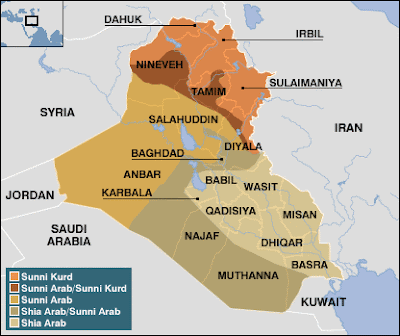
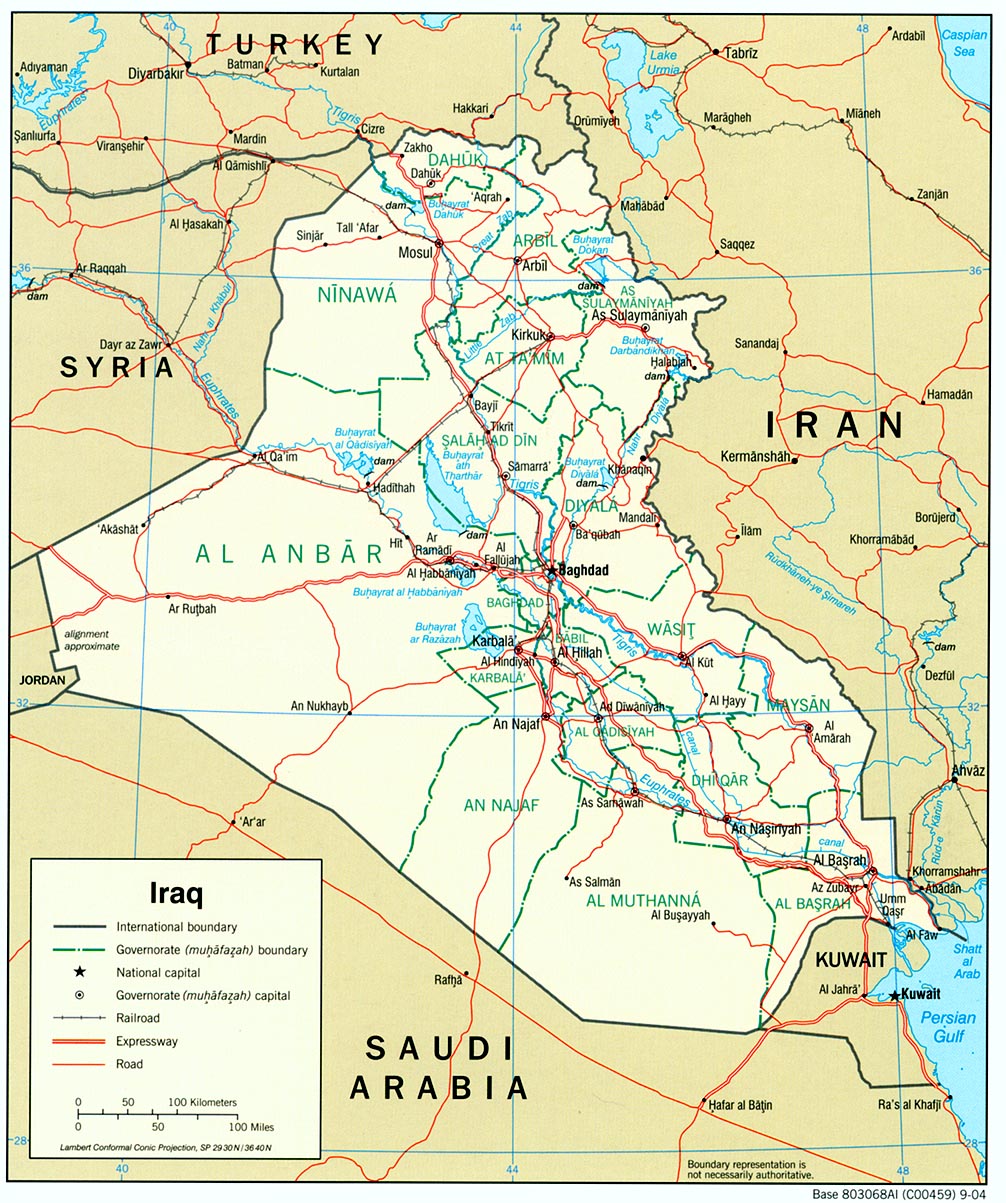
casualties by province; general ethnicities by province; northen cities


link: MG Mixon, new guy on the block, gives a view from the North:

  • Two of six Provinces quiet (Sulaymaniyah, Dahuk) area of 11 million people the size of Pennsylvania, roughly.

  • At-Takim (Kirkuk) and Salah ad-Din suffer attacks on infrastructure

  • Diyala (Ba'qubah, etc.) terorrist induced sectarian violence, with militia counter-attacks and corruption of police/army

  • Nineveh - today (Dec 1) gets first division completely solely under IGFC (Iraqi Ground Froces Control)

Police, army, and border security forces -- all in play
Five divisions to be completely under IGFC by February.

I got the sense that training was going to be 'on-the-job', to accelerate the transitions, rather than via an approach of 'schoolroom first' and field-experience later (cf. "mobile training teams" ...).

Little comment on the role of the Peshmurga.

UPDATES LACK STRATEGIC CONTEXT

We get a sense of some forward motion from these snap-shot pictures. Some things are moving in the right direction.

What is the target structure of the Iraqi forces and what is the projected percentage completion? Perhaps four divisions is enough, but the size of battlions can vary, so its not clear how many this involves. 36,000 police is impressive, but how many more are needed to reach critical mass or widely accepted civilian protection ratios?


Background:
During the late 1970s and the mid-1980s, the Iraqi armed forces underwent many changes in size, structure, arms supplies, hierarchy, deployment, and political character. Between 1980 and the summer of 1990 Saddam boosted the number of troops in the Iraqi military from 180,000 to 900,000, creating the fourth-largest army in the world. With mobilization, Iraq could have raised this to 2 million men under arms--fully 75% of all Iraqi men between ages 18 and 34. The number of tanks in the Iraqi military rose from 2,700 to 5,700 and artillery pieces went from 2,300 to 3,700.

The regular Army in mid-1990 consisted of more than 50 divisions, additional special forces brigades, and specialized forces commands composed of maneuver and artillery units. Although most divisions were infantry, the Army had several armored and mechanized divisions. Some armored units had a small amount of modern Western and Soviet equipment, but most of the Army had 1960s-vintage Soviet and Chinese equipment. Training and equipment readiness of Army units varied greatly, ranging from good in the divisions that existed before the Iran-Iraq war, to poor in the largely conscript infantry formations.
http://www.globalsecurity.org/military/world/iraq/army.htm

Thursday, November 30, 2006

"Fallujah today is a boom town" for construction

Video-link briefing from Marine Col Larry Nicholson, Regimental Combat Team 5 Commander (The Fighting Fifth, the Marine Corp's most decorated unit).

Facts on the ground, the rest of the picture:


  • Elected, functional city government, despite intimidation campaign
  • populace has returned following violence / earlier pacification campaigns,
  • relative safe-haven status vis-a-vis current Baghdad,
  • U.S. troop drawdown from 3,000 to 300; nine Iraqi battalions - needs to double
  • Americans working alongside Iraqis, including businessmen; but police development is slow.
  • Six entry points to the city,
  • everyone with ID-resident badges (no refugee camps - families in Fallujah help those displaced in need),
  • five (5) incidents a day, including non-lethal, in overall city of 400,000
(paraphrase) "In the middle of a Sunni insurgency, but we are the best friends of the Sunni population here. The Iraqis we're working with here thoroughly understand that."

Video Link

Quotus re Quotus - Counterinsurgency quote for the day

Unlike Alice talking to the Cheshire cat, sometimes you don't know where you are, even if you know where you are going:

From the Princeton Project on National Security (link):

...both counterinsurgencies and counterterrorist campaigns share another troublesome similarity: the difficulty of determining who is "winning." Body counts and other measures of effectiveness (MOEs) drawn from traditional conventional wars provide misleading indicators... Indeed, as ... Rumsfeld pointedly asked in 2003, "are we capturing, killing, or deterring and dissuading more terrorists every day than the [religious schools] and the radical clerics are recruiting, training, and deploying against us?"*...

Even in retrospect, it is difficult to determine which factors had the most impact on the course of the fighting and if and when a turning point occurred. Given these conflicts' protracted nature and the absence of major military engagements, it is also important to understand the adversary's measures of success and to distinguish between short-term MOEs (terrorist leaders eliminated, funds blocked, etc.) and long-term indicators of progress (democratization of the Middle East, de-legitimization of terrorism, etc.).

The American Experience in Vietnam underscores this measurement problem. The CIA established a Hamlet Evaluation System (HES) to provide MOEs for the pacification campaign. This computer-based system incorporated monthly feedback ... Despite these endeavors, the HES could not overcome the perception that it exaggerated progress in pacification, especially before the 1968 Tet offensive.

History provides other examples of the difficulty in assessing an ongoing insurgency. In Algeria and Vietnam, the French and Americans "won" almost every battle until they lost the war, while for a long time in Malaya the British justly feared another defeat in their effort to retain their original colonial empire. Terrorist campaigns also have been replete with rapid and unanticipated changes in fortune. In the early 1980s, the Lebanese terrorist group Hizbollah achieved a sudden triumph after several of its operatives inflicted devastating suicide strikes...
------
*It has been reported, as I recall, the Rummy's DoD actually went through this estimation exercise and that the preliminary results were not laudatory, therefore the reports were sent back for re-working. I don't have a reference, but I believe I read it either in RicK's or Suskind's reporting.

A Page from Counterterrorism History

The missing metrics. The need to retool the DoD for a long conflict, in terms of incentives, training, and more. New governmental/organizational approaches to deal with the long-term nature and comprehensive character of the problem:

Have we fashioned the right mix of rewards, amnesty, protection and confidence in the US?

Does DoD need to think through new ways to organize, train, equip and focus to deal with the global war on terror?

Are the changes we have and are making too modest and incremental? My impression is that we have not yet made truly bold moves, although we have have made many sensible, logical moves in the right direction, but are they enough?

Today, we lack metrics to know if we are winning or losing the global war on terror. Are we capturing, killing or deterring and dissuading more terrorists every day than the madrassas and the radical clerics are recruiting, training and deploying against us?

Does the US need to fashion a broad, integrated plan to stop the next generation of terrorists? The US is putting relatively little effort into a long-range plan, but we are putting a great deal of effort into trying to stop terrorists. The cost-benefit ratio is against us! Our cost is billions against the terrorists' costs of millions.

Do we need a new organization?


That was Donald Rumsfeld, in October of ... 2003.

The need for bold initiatives and long-term planning was on the CIC's desk back in 2003, not shifts in tactics under the rubric of stay-the-course.

Zakaria: Extricate Now from Sectarian Strife

The assumptions for the National Strategy for Victory in Iraq are probably violated by the emergence of sectarian violence, either entrenched but small or passing but escalating/large.

MORE TO DO BEFORE HEADING FOR THE EXIT?

In his recent piece, Zakaria goes one step farther, suggesting that the appropriate re-make of that strategy is retrenchment in the form of exit.

I have a question about whether the U.S. can walk a middle line, without becoming truly hated for its efforts. Would it be possible to add more troops to stall the Sunni Insurgency and to strengthen the lawful constraints on the Shia government, either by fiat or by manipulating the levers of the government to keep the "extra-judicial" Sadrists 'contained' or 'constrained' under judicial enforcement. In other words, is there a way to position the effort so as to continue to fight for law-and-order, which is how the U.S. might garner credibility and where others can lose legitimacy?

A guarantee of the sanctity of the ballot box is another reason to argue for a continued U.S. presence. Perhaps that doesn't make sense in a full-blown civil war scenario, the upshot of which is the consolidation of the ballot box by violent means. Still, if the outcome is imperfect, the U.S. might have a role to play, rather than turn the whole course of events over to other parties.

One wonders if the Arab street might ever turn against further sectarian violence. It wasn't so long ago that there was great hand wringing that non-Muslims were going to destroy the ancient city of Baghdad (bombs), but what about the al-qa'ida, the sunni insurgency, and the reprisal militia destruction? Can that all be forgiven, without even a groan?

ARE ALL THE WINNING CARDS ALREADY DEALT AND PLAYED?

There are other political cards to play. Withdrawal is not the only way to incent Iraqi cooperation. It might be possible to suggest an end to a central government, for a period, on the grounds that it is not supplying any public goods (and violating its constitutional oath).

It might also be possible to curb Iran by threatening an independent Kurdish state, something that would be very dangerous to the Iranian Mullah oligarchy (of course, Turkey would have to be insiders to this threat).

Syria can be easily pressured too, in a true game of brinkmanship. If both Iraq and Lebanon fall into a broad-based civil war in the next 12 months, Syria will be at its weakest point in decades, maybe.

TO BOLDLY GO: UP TO THE TASK?

None of these are guranteed, but it does seem that there are political pressure points yet to be pressed. Perhaps President Bush doesn't have the mind for this kind of chess. He seems to prefer a business-like or Texan way of "looking people in the eye" and saying that they are "a man of peace" or "deserving of a chance".

In some ways, the CIC seems hampered by his or his general's willingness to 'think Big', not in ideological terms, but in practical terms of what might be required to tip the scales beyond mere capture and kill. I cannot help but think that there would be a sharp psychological impact, in the short run, if a massive force of 50,000+ troops marched into Baghdad (U.S. or otherwise). Declaration of martial law, a high-tech intelligence effort to find out who is in the city and where, and the holding of municipal elections, so that the Sunni can have another try at getting included in local councils and the political track can have a chance.

The temporary use of large-scale force can have some effects, like returning a temporary sense of normality, re-iterating that there are true political choices to be made (not just chaos/hopelessness to be submitted to). A large, mobile force could also be re-deployed for perimeter operations elsewhere, which are also a part of clear-hold-build, at various stages.

CHAOS ISN'T JUST FOR BREAKFAST ANYMORE

Separately, I have to say, with great sadness, however, that I've seen the first convincing evidence for the second of my own two conditions for prescribing a stand-aside strategy on the blog that Zakaria mentions, Model Iraq. (I don't say what they are, lest they become self-fulfilling).

On my own account, the campaign is on borrowed time, playing against the odds, as it were, for an outcome that will not involve substantially more violence. The only thing that prevents more conviction on this score is that I continue to feel that I don't have sufficient information about the whole situation.

IF THE WORST IS YET TO COME, RETREAT IS ONLY THE BEGINNING

Iraq is not Vietnam. There are reasons to believe that a full-scale civil war might be self-contained, but also reason to believe that it could draw in other partners, especially as part of the end-game. In other words, if the Shia start to "win", the temptation for neighbors will be to assist the Sunni, etc. The Yemeni civil war drew in outside participants, lasted seven years, and ended in a compromise as the parties realized that foreign offers of help weren't going to resolve the situation.


Update: Suadi Arabia signalling in strongest possible terms that it will not stand aside in a Iraqi Civil War precipitated despite or because of a U.S. withdrawal:

Because King Abdullah has been working to minimize sectarian tensions in Iraq and reconcile Sunni and Shiite communities, because he gave President Bush his word that he wouldn't meddle in Iraq (and because it would be impossible to ensure that Saudi-funded militias wouldn't attack U.S. troops), these requests have all been refused. They will, however, be heeded if American troops begin a phased withdrawal from Iraq. As the economic powerhouse of the Middle East, the birthplace of Islam and the de facto leader of the world's Sunni community (which comprises 85 percent of all Muslims), Saudi Arabia has both the means and the religious responsibility to intervene.

Writing in the WaPo, the author is a Saudi insider.

Wednesday, November 29, 2006

Newt, Pre-empting the Iraqi Study Group

link - Newt takes up the Iraqi Study Group

1. Does the Commission Have a Vision for Success in the Larger War Against the Dictatorships and Fanatics Who Want to Destroy Us?

I think that few are left who do not realize that there is a larger struggle for legitimacy, or as Tony Blair has put it, "Whose values will lead into the 21st Century", but not many agree on what the implications of that are for tactics, duration, resourcing, involvement.

I would bet dollars that the Study Group will have recommendations on how to confront radical ideologies within Islam. However, they may end up too vague, like "adopt a comprehensive approach" or "adopt long-term strategies".

2. Does the Commission Recognize That the Second Campaign in Iraq Has Been a Failure?

Their staff may not be able to agree why it has been a defeat, even more so without a classified clearance, so it may not be productive to declare a defeat.

3. Does the Commission Recognize the Scale of Change We Will Need to Adopt to Be Effective in a World of Enemies Willing to Kill Themselves in Order to Kill Us? Learning to win requires much more than changes in the military. It requires changes in how our intelligence, diplomatic, information and economic institutions work.

It seems unlikely that there will not be a battery of bureaucratic recommendations and changes to institutionalization, many including taking the military out of the 'lead', if Newt is ready for that ...

4. Does the Commission Describe the Consequences of Defeat in Iraq?
What would the withdrawal of U.S. troops in Iraq look like?

The larger military question is whether so much matters. In a purest sense, there are no such thing as 'unacceptable consequences' - war is Hell. When you go to "war", you accept even the unintended consequences, the Pandora's box that it opens, yes?

All quagmires are political, not military. As such, the Iraqi campaign is on borrowed time, by many metrics.

5. Does the Commission Understand the Importance of Victory? Winning is key. Time is on the side of those seeking nuclear and biological weapons to use against the civilized world.

Yet, time is exactly what is required for the scale of transformation that is necessitated.

"Victory" is misstatement or a poor choice of words. The near-term goals are containment, the mid-term goals are pressure, and the long-term goals are attenuation. The more one thinks in terms of a decisive "victory" the LESS likely it becomes.

6. Does the Commission Define What It Means to Win, or Simply Find a Face-Saving Way to Lose? Winning is very definable. Can we protect our friends and hurt our enemies?

It seems contradictory to suggest that the second campaign was a defeat but to suggest that a third is possible to "win".

It would not be reasonable to calibrate goals beyond what the facts on the ground make possible.

What's more, it seems to me more robust to come up with a perspective in which all outcomes are covered by a set of goal statements, recognizing that a significant portion of the outcome is not in the control of the U.S., either in the hands of an Iraqi government or others.

7. Does the Commission Acknowledge That Winning Requires Thinking Regionally and Even Globally?

humm...

Well, Saudi Arabia is spending millions on a medium-term (3+year) project to seal its border electronically with Iraq.

Newt sounds like he is looking for military escalation here, with "direct confrontation" of Syria and Iran. Of course, if he means "Karine-A" type evidence, then he ought to say so. That kind of evidence could be used quite successfully in non-military ways.

8. Any Proposal to Ask Iran and Syria to Help Is a Sign of Defeat. Does the Commission Suggest This? Iran and Syria are the wolves in the region.

Any proposal? Even "enemies" can cooperate to prevent the plug from being pulled on them both ...

9. Does the Commission Believe We Can 'Do a Deal' With Iran? The clear effort by the Iranians to acquire nuclear weapons and Ahmadinejad's assertion that it is easy to imagine a time in the near future when the United States and Israel have both disappeared should be adequate proof that the Iranian dictatorship is the active enemy of America. Couple that with the fact that the Iranians lied to the International Atomic Energy Agency for 18 years while trying to develop a nuclear weapon. Either this is a dangerous regime we need to fundamentally change, or it is a reasonable regime with which we can deal.

Too much either/or thinking, here. Besides, what nation lives 'without enemies' in modern times?

Nuclear proliferation has to be put on a separate plate than other issues, and cannot be, as Newt suggests, a matter of 'friends and enemies', at least among nation-states.

The rest of the issues with Iran are more nettlesome and what are the options to doing deals or making agreements, really?


10. Does the Commission Believe We Are More Clever Than Our Enemies?
The al-Assad family has run Syria since 1971.

Well, Syria is needed for a settlement of the I/P issue, one way or the other ...

11. Does the Commission Recognize the Importance of Working With the Democratic Majorities on a Strategy for Victory? The Democratic victory in the 2006 election should not be used as an excuse to do the wrong thing. The Democrats are now confronting the responsibility and burden of power. Opposition to continuing the failed second campaign should not be translated into opposition to an American victory.

The burden of power? The burden of prior mistakes ...

The issue of a third-campaign is whether it meets its burden of proof, empirically, not ideologically. And that's how it ought to be.

Tuesday, November 28, 2006

The Grim Visage of the Infernal Invitation of Terrorism ...

From TNR (hat tip, AS), a picture of how clear-hold-build is a strategy that has not been executed too often in favor of shuttling around troops in a whack-a-mole approach.

As one officer remarked to Congress, how can you leave [pull out or drawdown] and then expect the populace to welcome you back when or if you return? It's a relentless effort to get it right consistently, a constant pressure campaign that requires forward motion, a steady struggle to maintain whatever trust and predictability has been built.

But either way, a persistent and tragic theme of our operations in Iraq has been the one-step-forward-two-steps-back sliding of towns and regions in and out of security: Through immense effort American forces will calm a city, then troops there will be drawn down and all their work will be lost; and on, and on, and on. Lawrence has written several persuasive stories for us on Tall Afar, the insurgent Northern Iraq outpost tamed by innovative and amazingly intense military efforts to connect with its population; he also lamented what may happen when these particular now-expert troops are blindly rotated out of the town as was scheduled
What is more alarming is this conclusion, that al-qa'ida is able to consolidate politically gains from the chaos they impose:

By Dafna Linzer and Thomas E. Ricks
Washington Post Staff Writers
Tuesday, November 28, 2006; Page A01

The U.S. military is no longer able to defeat a bloody insurgency in western Iraq or counter al-Qaeda's rising popularity there, according to newly disclosed details from a classified Marine Corps intelligence report that set off debate in recent months about the military's mission in Anbar province.


This conclusion is debated in the story by an intelligence official. The TNR picture is also a mosaic truth.

Together, these imply that the uncertainty is still very high.

However, one does start to get the sense that al-qa'ida, alongside the insurgency, have gotten quite good at refining tactics: Random violence and post-verbal evil to tear at the fabric of society (al qa'ida) and fear, greed, and intimidation to consolidate political power (the insurgency).

Monday, November 27, 2006

The Knife's Edge: Beyond Constructive Tension, At the Limit of Reason

Nothing to add to this. Speaks for itself.

KING ABDULLAH: Well, ..., the difficulty that we're tackling with here is, we're juggling with the strong potential of three civil wars in the region, whether it's the Palestinians, that of Lebanon or of Iraq.

And I hope that my discussions, at least, with the president will be to provide whatever we can do for the Iraqi people. But at the same time, we do want to concentrate ourselves on the core issues, which we believe are the Palestinians and the Palestinian peace process, because that is a must today, as well as the tremendous concern we've had over the past several days, what's happening in Lebanon.

And we could possibly imagine going into 2007 and having three civil wars on our hands. And therefore, it is time that we really take a strong step forward as part of the international community and make sure we avert the Middle East from a tremendous crisis that I fear, and I see could possibly happen in 2007.


The al-qa'ida strategy to increase sectarian strife ... works.

Is the 'logic' of retaliation inexorable? Are the forces of chaos always stronger in the short term? The long-term? Are people necessarily at the mercy of their prejudices, even in the face of a greater enemy? Can 'conditions' be arranged that 'force' retaliation, and a spiral of escalation? Can a few dictate the path for the whole, in that regard, without fail? Is it a question of once it starts, the chance to stop it has ended, the fate sealed (a one-shot deal; an pound of prevention to prevent a disease that must run its course if caught)?

Are there any gains to be consolidated from sectarian strife? Is it really a path to military success and political control?

There may be some game-theoretic approaches to these question. One wonders if the Army is up to speed on that, let alone the civilian leadership.

Sunday, November 19, 2006

Is the Government Following its Own 'Strategy for Victory in Iraq'?

ABIZAID TESTIFIES BEFORE CONGRESS

General John P. Abizaid, the man with more stress in world than Atlas in the Old World, offered up a careful assessment of the current situation in Iraq.

Is there evidence that the Government is following its own announced Strategy for Victory? How do we get over the hump of whether more is needed before less is accepted, if we can? There are so many issues/questions to look at, I'll just confine to these two.

IS THERE A SHARP EYE ON THE CHOSEN STRATEGY AND TOOLS?

It is easy to lob criticisms from every direction imaginable at people who are trying to run with the ball, as much as we have relegated the military to do so, for this conflict, with a sort-of closed-door vision of what to do and how to do it.

Yet, we still have the basic document that is meant to be informing the public about what are the steps to getting to goal, the administrations National Strategy for Victory in Iraq.

That document calls for short-term, medium-term, and longer-term goals. We don't see any of the present status reporting broken out into those categories, even if people are thinking of it. We appear to continue, even at this late date, to be asking questions about what the administration lists as a 'short-term' goal, namely the standing up of Iraqi Security Forces.

I may have surely missed them, but I didn't see much discussion about whether long-term goals were being met in places that had more stability, like the North and the South.

THE NINA, THE PINTA, AND THE SANTA MARIA

To reach the proverbial New World, the National Strategy document breaks down three conceptual areas, with the following strategies:

Political Track: Isolate, Engage, and Build
Security Track: Clear, Hold, Build
Economic Track: Restore, Reform, Build

Elsewhere the document invokes 'expanding political participation'. In the details, one finds the assumptions on which this strategy is conditioned.

Ambassador Satterfield injects a new "three pillars" element, but this is not new to the overall position, just, perhaps, a new area of rhetorical emphasis.

NO 'STRATEGY' FOR SECTARIAN VIOLENCE?

The rise in sectarian violence isn't covered by the National Strategy document.

What appears to have happened is that the an urgent emphasis on 'reconciliation' in the Political Track, which has involved a re-work of the Bremer-era de-Ba'thification, has been legislated in conjunction with a new military emphasis on Baghdad in the Security Track, supplied by soldiers from some other effort.

The Ambassador notes the simulataneity of the equations for each track; however, he suggests that only from the safety of a secure situation can the right compromises be reached. Elsewhere, the General suggests that only faced with the need to provide for their own security will the Iraqis themselves stand-up, so that the US soldiers can stand down. Apparently, these two seemingly opposed positions are resolvable.

THE ECONOMIC TRACK

THE POLITICAL TRACK - MUNICIPAL ELECTIONS AMID 'CHAOS'

THE TROOP DEBATE

[to be continued after the show]

Thursday, November 16, 2006

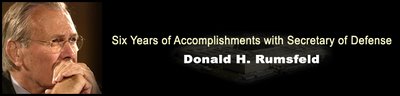
Rumsfeld Posts His Resume on Web


There is a lot more to be written about and by Rumsfeld.

Donald-the-Liberator is not waiting, however. He's taken the time to list the most important things that occurred on his watch (see pic/link).

What was in his letter of caveats to Bush-43? Did he really want to turn Iraq over to the former Army and leave - if so, was he prepared to resign as a matter of conscience when it was clear that others wanted to prolong a U.S. stay? The list goes on. So much more yet to be told "For the Record".

Monday, November 13, 2006

No Separate Peace ...

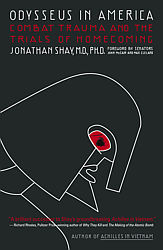
Dr. Johnathan Shay pens a tomb that attempts to frame the soldier in society.

What is the way back home? Can't sleep? Feel detached, even from loved ones? Flashbacks. No desire to talk about "it". Alone in a crowd. Hopelessly alienated from a hum-drum work-a-day world?

All these and much more about the combat adaptations that can cause temporary injury or that can fester and get worse, as with any wound.


From Houghton Mifflin, a step-by-step experiential survey from the flipside, from those for whom "deployment" is a household term.

A journalist wife of an army chaplain, Kristen Henderson tells it simple and straight (Hemmingwayesque). She includes a Resources and Actions list, that includes "10 Ways to Really Support the Troops" and link to TAPS (support network for survivors).

Excerpt:

I was visiting Fayetteville, North Carolina, home of the Army's Fort Bragg, when a friend said he knew a woman who needed to talk to me. He introduced me to Beth.

"This is our first deployment," she said.

Her eyes were wide and blue green and shadowed by her straight, dark hair. She gave me a level look before withdrawing her gaze and adding, "They say it's supposed to get easier but it's been four months and so far it's just been hard. When does it get easier?"

"Oh," I said, and the oh dragged itself into a sigh while I tried to decide whether or not to lie. I wanted to fix it for her; I wanted to make it all right. But I knew the only thing that would make everything right would be for her husband to walk through that door right now, safe and whole in body and mind, the same man he was when he left. So in the end, I couldn't. I couldn't lie to her. When does it get easier?

"It doesn't," I said. "Wartime deployments are always hard."

"Don't tell me that," she said.

But they are, they're just so hard. Eventually you figure out ways to cope -- or not. But they never get easy. A wartime deployment is always a mountain, no matter how you climb it.